June 25, 2024

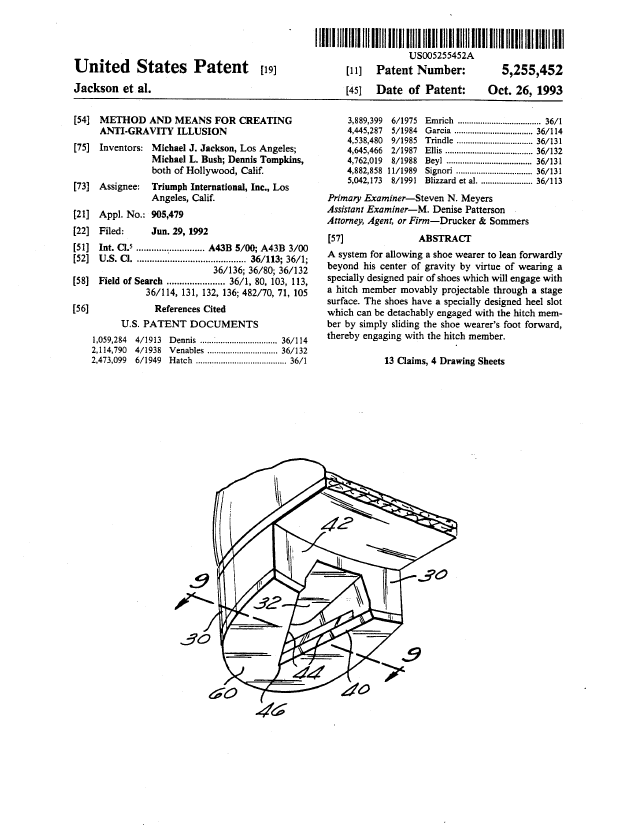
June 25 is the anniversary of Michael Jackson’s death in 2009. Michael Jackson is remembered for many things, but he is probably not remembered by most people as an inventor — but he was. Michael Jackson received U.S. Patent No. 5,255,452 on a Method and Means for Creating Anti-Gravity Illusion:

This would appear to be what might have been used in Jackson’s 1988 Smooth Criminal video (see below), but the October 13, 1988, release date of the video and the June 29, 1992, filing date of the application don’t seem to match up.

Maybe Jackson was protecting a later-developed improvement to the illusion in the video. Otherwise, the one-year public use bar would seem to be a problem.

Anyway, RIP Michael Jackson, entertainer and inventor.

A Conventional Business Practice Executed by Generic Computer Components Cannot Survive Alice/Mayo Step 2

In Beteiro, LLC v. Draftkings, Inc., [2022-2275, 2022-2277, 2022-2278, 2022-2279, 2022-2281, 2022-2283] (Fed. Cir. 2024), the Federal Circuit affirmed the dismissal of a suit for infringement of U.S. Patent Nos. 9,965,920, 10,043,341, 10,147,266, and 10,255,755 for failure to state a claim based on the subject matter ineligibility of the patent claims.

All of the patents share a common specification and title: “Apparatus and Method for Facilitating Gaming Activity and/or Gambling Activity.” The patents disclose a purported invention which “facilitate[s] gaming activity and/or gambling activity at a gaming venue remote from the user’s or individual’s physical location” such that the user can “participate in live gaming activity and/or gambling activity via a user communication device” even if the user is not in the same location as the gaming venue.

At step one of the Alice/Mayo test, the Federal Circuit agreed with the district court that Beteiro’s claims are directed to the abstract idea of “exchanging information concerning a bet and allowing or disallowing the bet based on where the user is located.”

The Federal Circuit said that the claims exhibit several features that are well-settled indicators of abstractness:

  • First, the claims broadly recite generic steps of a kind frequently held to be abstract (detecting information, generating and transmitting a notification based on the information, receiving a message (bet request), determining (whether the bet is allowed based on location data), and processing information (allowing or disallowing the bet).
  • Second, the claims are drafted using largely (if not entirely) result-focused functional language, containing no specificity about how the purported invention achieves those results.
  • Third, there are several precedents where broadly analogous claims, such as those involving methods of providing particularized information to individuals based on their locations, to be abstract.
  • Fourth, the district court was able to persuasively analogize Beteiro’s patent claims to longstanding “real-world” (“brick and mortar”) activities.

At step two, the district court found that the representative claim failed to provide an inventive concept because it achieved the abstract steps “using several generic
computers – namely, a ‘computer,’ a ‘communication link,’ a ‘first communication device,’ a ‘second communication device,’ and a ‘global positioning device.’” The district court thus concluded that the claim that simply describes a conventional business practice executed by generic computer components cannot survive Step 2. The Federal Circuit agreed.

Posted in 101

June 21, 2024

236 years ago today, New Hampshire became the ninth state to ratify the Constitution, and the U.S. Government was off and running. During the Constitutional Convention of 1787, both James Madison of Virginia and Charles C. Pinckney of South Carolina submitted proposals that would allow Congress the power to grant copyright for a limited time. (Pinckney’s South Carolina was the first state to enact its own patent law). James Madison wrote in the Federalist, “the States cannot separately make effectual provision” for the protection of invention and so in drafting the Constitution of the United States, responsibility for providing such protection was entrusted to the Congress of the United States. Madison’s and Pinckney’s proposals resulted in Article I, Section 8, Clause 8, which provides:

“The Congress shall have Power … To promote the Progress of Science and useful Arts, by securing for limited Times to Authors and Inventors the exclusive Right to their respective Writings and Discoveries.”

The First Congress in 1789 considered patent and copyright legislation. On January 8, 1790, during his first State of the Union, President Washington called on Congress to establish act on the Constitutional authorization, urging Congress to pass legislation designed for “the promotion of Science and Literature” “so as to better educate the public.”

On April 10, 1790, Washington signed into law the first Patent Act, and Samual Hopkins must have been waiting in the lobby because the first United States patent issued to him a few months later on July 31, 1790. The Patent Action of 1790 did not establish a Patent Office, and instead the submissions were examined by a committee, including Thomas Jefferson, that not only decided whether to issue a patent, but for how long (the Patent Act set the maximum term at 14 years). A grand total of three U.S. patents issued in 1790, and a total of 57 patents were issued under the Patent Act of 1790, before it was replaced with the Patent Act of 1793, which among other things, eliminated examination!

On May 31, 1790, Washington signed into law the first Copyright Act. Prior to the passage of the Constitution, several states passed their own copyright laws between 1783 and 1787, the first being Connecticut. This Copyright Act of 1790 granted authors the exclusive right to publish and vend “maps, charts and books” for a term of 14 years, renewable for one additional 14-year term, if the author was alive at the end of the first time. The Copyright Action of 1790 had a longer run than the Patent Act of 1790, being amended in 1802 and 1819, and replaced by the Copyright Act of 1831.

June 20, 2024

The movie Jaws premiered forty-nine years ago today. U.S. Patent No. 4602384, which issued July 29, 1986, on an Aquatic Attack Protection Suit and Material Therefor may have been inspired by the 1975 movie:

A few years earlier in 1982 Jeremiah Sullivan received U.S. Patent No. 4356569 on an Armored Skin Diving Suit:

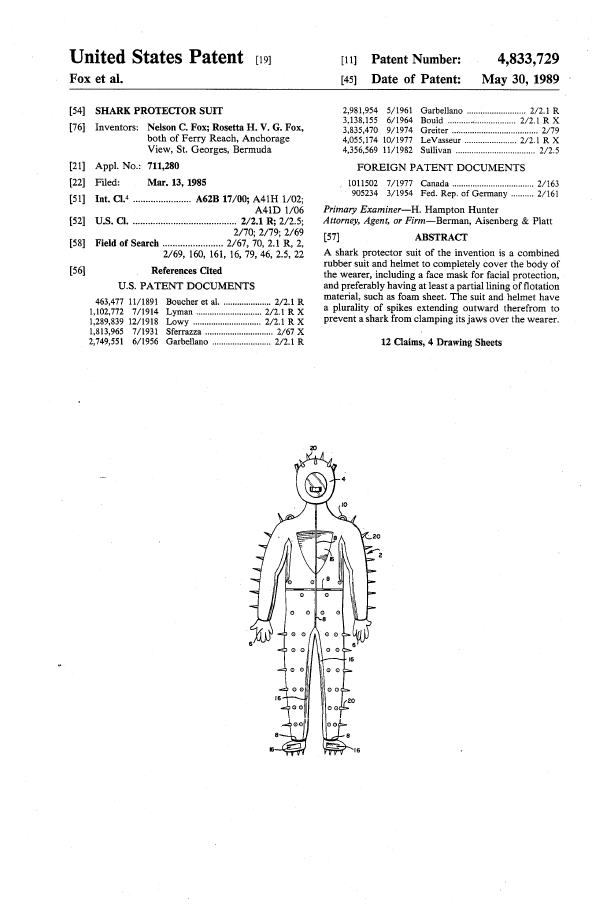
Is it really skin diving if you are wearing armor? Inventors Nelson and Rosetta Fox took the concept further in their 1989 U.S. Patent No. 4833729 on a Shark Protector Suit:

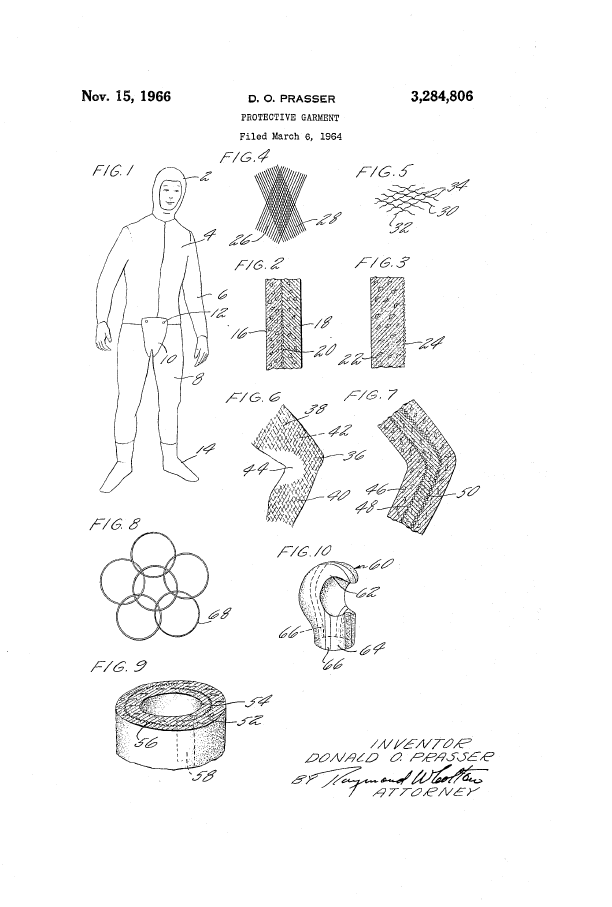
However, shark protection technology predates Jaws. In 1966 Donal Prasser received U.S. Patent No. 3284806 on a Protective Garment that essentially employed chainmail to ward off sharks and other predators:

The publicity for Jaws warned “You’ll Never Go In The Water Again.” But once again, inventors have our backs. They have protected us from sharks (but what’s going to protect us from shark suits?

Juneteenth 2024

According to the USPTO, three US patents have issued referencing Juneteenth: 11803924, 11281738, and 8136962 (Google Patents is only aware of the ‘962 patent — good lesson to search both databases). There are some pending applications on mentioning Juneteenth, so there will likely be more in the future.

A seemingly more significant event is the Emancipation Proclamation, from which Juneteenth derives. According to the USPTO the Emancipation Proclamation is referenced in 24 US patents Google Patents is only aware of 23 patents, but identifies one much older patent (before USPTO full text searching), and two fewer recent patents indicating a lag in Google Patents data uploading, again a good lesson to search both databases).

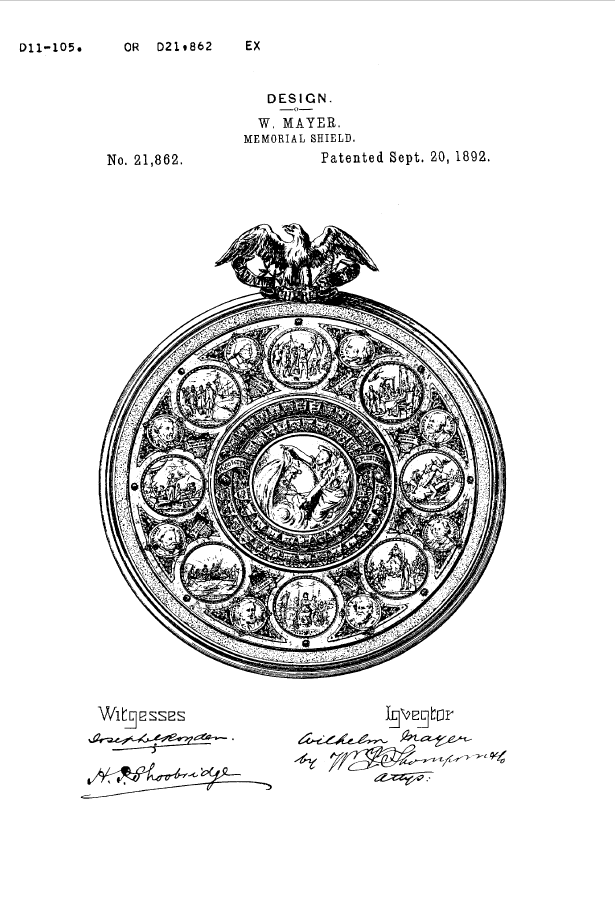
US Patent No. D21862 is the earlier patent identified by Google Patents, and it covers a memorial shield:

The shield is interesting for its revelation of the historic events and persons of significance in 1892:

The large medallions on the shield depict, “Landing of Columbus,” “Landing of the Pilgrims,” “Battle of Lake Erie,” “Washington Crossing the Delaware,”Declaration of Independence,”“Battle of Churubusco,” “Emancipation Proclamation,” and an allegorical design of industrial progress. The smaller medallions depict George Washington, Benjamin Franklin, Abraham Lincoln, James A. Garfield, Ulysses Grant, Thomas Jefferson, H. Wadsworth Longfellow, and Sam. F. B. Morse. Some of these events and persons would likely still be listed today, but with the march of time comes a continual reassessment of what (and who) is important. The Emancipation Proclamation, and its echo Juneteenth, still make the list.

June 18, 2024

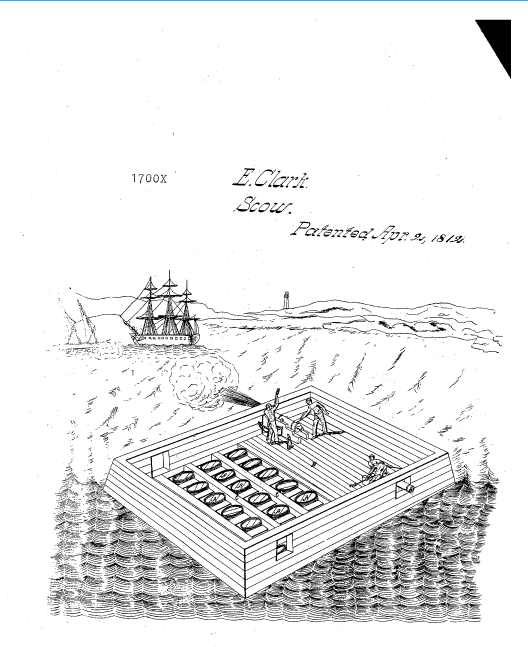
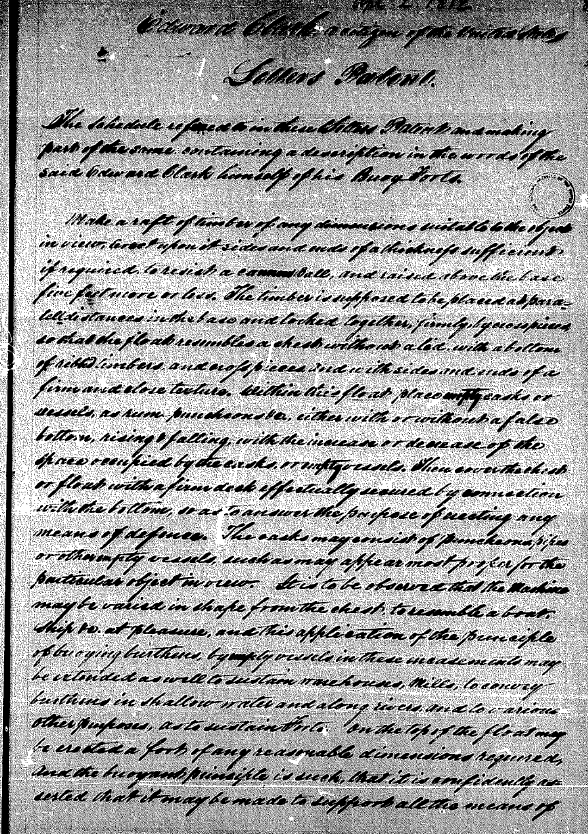
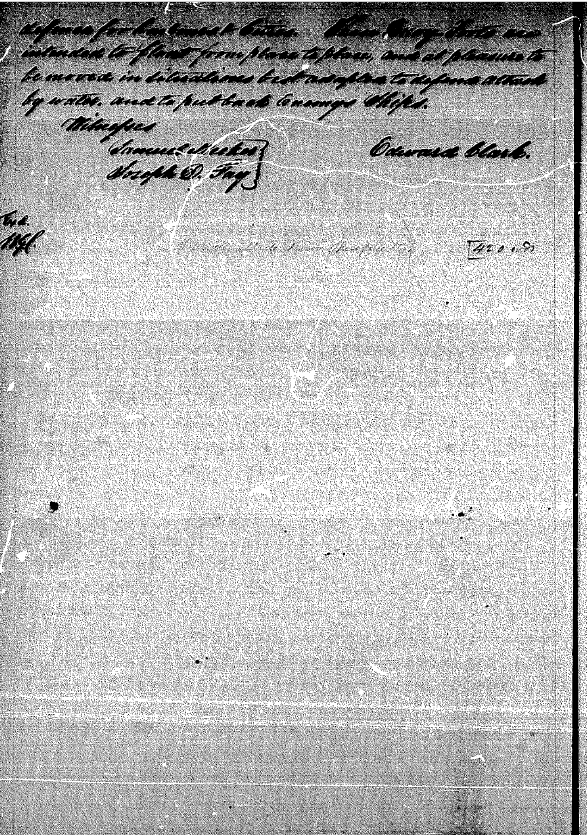
On this day in 1812, the U.S. declared war on Great Britain, starting the War of 1812, which persisted until February 17, 1815, when Congress ratified the Treaty of Ghent. 1812 was not a particularly active year for patents, with just 29 issued (compared to 348359 issued in 2023). Most related to mundane things like curing leather or ovens, but one may have presaged the impending war. U.S. Patent No. X1700 issued April 2, 1812, to Edward Clark:

Plaintiff Failed to Show It was Entitled to a Preliminary Injunction to Protect its Trade Secrets

In Insulet Corp. v. Eoflow, Co, Ltd., [2024-1137] (June 17, 2024), the Federal Circuit reversed a preliminary injunction against manufacturing, marketing, or selling any
product that was designed, developed, or manufactured, in whole or in part, using or relying on alleged trade secrets of Insulet.

Insulet and EOFlow are medical device manufacturers that make insulin pump patches. Insulet began developing the wearable insulin pump OmniPod® in the early 2000s. The FDA approved the first OmniPod product in 2005, and a next-generation product, the OPI-2, came onto the market soon thereafter in 2007. Insulet then began work on its next-generation Eros product, which obtained FDA approval in 2012 and commercially launched in 2013.

EOFlow began developing its own flagship product, an insulin pump patch called the EOPatch®, soon after the company’s founding in 2011. The EOPatch received regulatory approval in South Korea in 2017, after which EOFlow began developing its next-generation
EOPatch 2. Around that time, four former Insulet employees joined EOFlow. In 2019 and 2022, respectively, the EOFlow 2 received regulatory approval in South Korea and
Europe, after which it began commercial distribution in those select geographic markets.

After reports surfaced that Medtronic had started a diligence process to acquire EOFlow. Insulet sued EOFlow for violations of the Defend Trade Secrets Act. (“DTSA”), seeking to enjoin all technical communications between EOFlow and Medtronic in view of its trade secrets claims. The district court temporarily restrained EOFlow from “disclosing products or manufacturing technical information related to the EOPatch or Omni[P]od products,” and then granted Insulet’s request for a preliminary injunction.

The Federal Circuit began by noting that trade secrets are an important form of intellectual property that both Congress and the states have deemed worthy of protection. The Founders also recognized the value, as well as the volatility, of an idea kept as a secret. However in evaluating Insulet’s likelihood of confusion, the Federal Circuit noted that the court did not assess the statute of limitations in the context of evaluating Insulet’s likelihood
of success on the merits, the court thus ignored a material factor deserving significant weight, which constitutes an abuse of discretion. If the three-year statute of limitations for filing a DTSA claim had expired, Insulet’s claims would be timebarred and therefore would have no chance of success.

Further, even if the district court had adequately dealt with the statute of limitations issue, that would have been insufficient to support the October 24, 2023 order. As EOFlow further contends, the district court also abused its discretion in its consideration of what constitutes a trade secret. The Federal Circuit quoted the definition of trade secret in the DTSA, and noted that the definition used in the district court’s order was severely overbroad, including “any and all Confidential Information of Insulet” and “any information that contains, derives from, or incorporates such Confidential Information.”

The Federal Circuit also disagreed with the district court’s assessment that “it would be unfair to require at this stage perfection as to the precise number and contours of the trade secrets at issue.”

In order to secure a preliminary injunction, Insulet had to establish the likelihood of its success on the merits for at least one, specifically defined, trade secret. It did not do so. Rather, it advanced a hazy grouping of information that the court did not probe with particularity to determine what, if anything, was deserving of trade secret protection.

Finding that Insulet took measures to protect some unidentified “set of information” is not the same as finding that Insulet took reasonable measures to protect specific information alleged to be a trade secret, such as particular “design drawings and specifications for each physical component and subassembly,” as the DTSA requires.

The Federal Circuit found that because the district court failed to identify any trade secret with sufficient particularity, its analysis of misappropriation necessarily also fails as well.

The Federal Circuit concluded that in view of the failure to address the statute of limitations,
the lack of a tailored analysis as to what specific information actually constituted a trade secret, as well as the finding that it was “hard to tell” what subset of that information
was likely to have been misappropriated by EOFlow, we find that the district court abused its discretion in granting the preliminary injunction.

The Federal Circuit also agreed with EOFlow that the district court’s analysis of irreparable harm and public interest were flawed. The Federal Circuit made a point of stating that it was not deciding that Insulet has failed to adequately allege misappropriation of trade secrets or that it cannot succeed on the merits of its claims, only that Insulet has not proven it was entitled to a preliminary injunction.

June 17, 2024

On this day in 1885, the Statue of Liberty, a gift from the people of France to the people of the United States, arrived in New York Harbor. These days it would seem more like a gift from Ikea than France, the statue was in 350 pieces in more than 200 boxes.

The Statute of Liberty was patented by the sculptor, Auguste Bartholdi, six years earlier in 1879:

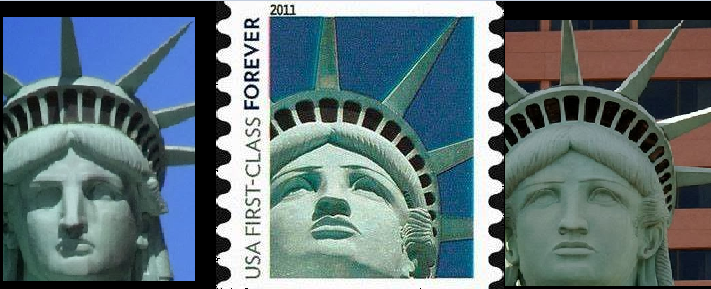
A peculiar IP side story is that in 2018 the U.S. Postal Services was ordered to pay artist Robert Davidson $3,554,946.95 for accidentally basing its 2011 Forever Stamp honoring the Statute of Liberty, not on the real Statue of Liberty, but on a stylized recreation Davidson produced for the New York-New York Hotel & Casino on the Las Vegas Strip.

The original, the stamp, and the Las Vegas versions.

The postal service sold more than 4,948,761,166 stamps with the unintentionally infringing image. The Court concluded that there were sufficient differences between the New York and Vegas statues to support a copyright claim.

Happy Father’s Day 2024

If you are still at a loss about what to get Dad, the U.S. patent collection is there for you.

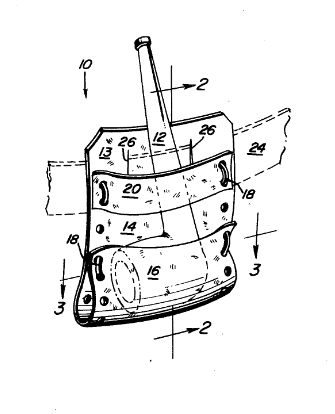
U.S. Patent No. 4,044,932 discloses a Smoking Pipe Sling, which the patent claims is appropriate for “young children wishing to make a gift for their father for father’s day,”

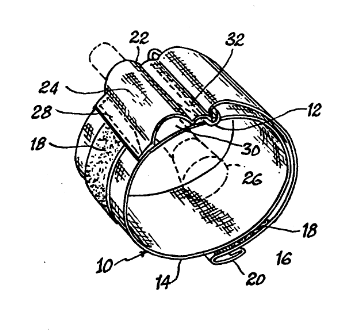
U.S. Patent No. 5,154,506 discloses a Flashlight Armband that the patent claims is “a good gift for Father’s day,”

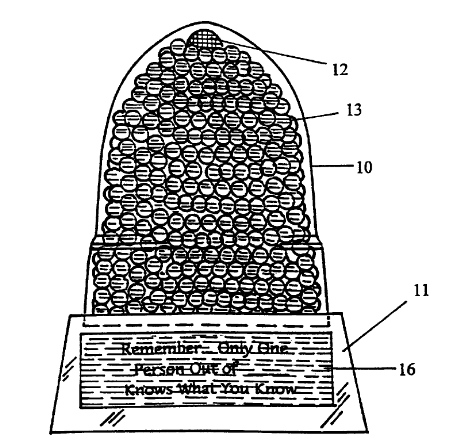
U.S. Patent No. 6,035,566 discloses a Desk Trophy that can be adapted for Fathers Day:

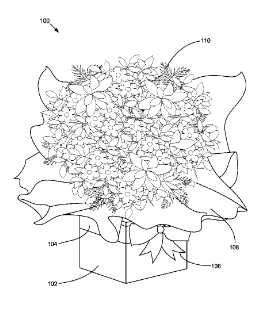
U.S. Patent No. 8,434,619 discloses an Apparatus For Presenting Botanical Arrangements which can have a Father’s Day theme:

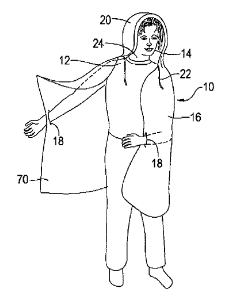
U.S. Patent No. 9,439,463 discloses a Combination Pillow/blanket/poncho Travel Accessory that makes “a great gift” for Father’s Day:

Happy Father’s Day to all of the fathers out there.

Flag Day 2014

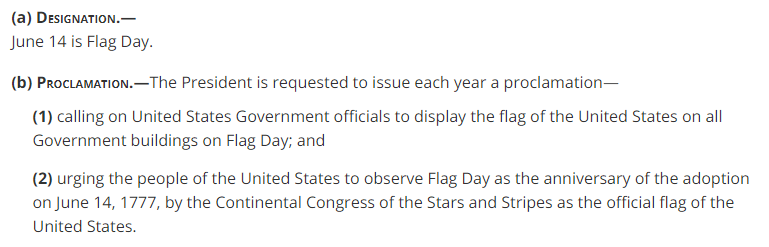
Flag Day commemorates the adoption of the flag of the United States on June 14, 1777, by resolution of the Second Continental Congress. In 1916, President Woodrow Wilson issued a presidential proclamation that designated June 14 as Flag Day. On August 3, 1949, National Flag Day was officially established by an Act of Congress, although Flag Day is not an official federal holiday. Title 36 of the United States Code, Subtitle I, Part A, CHAPTER 1, § 110 is the official statute on Flag Day; however, it is at the president’s discretion to officially proclaim the observance:

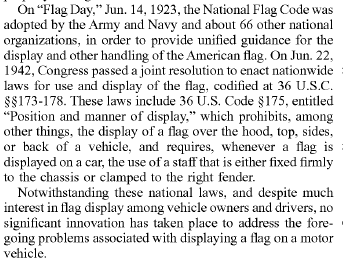
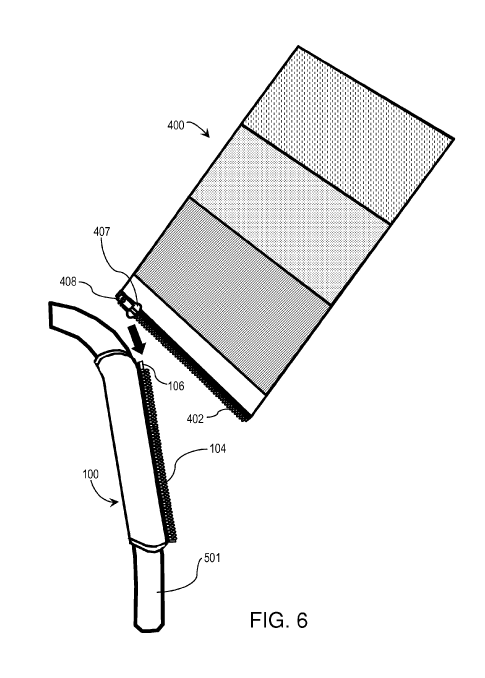
The Flag Code does more than create Flag Day, it sets forth rules for the proper care and display of the flag. In U.S. Patent No. 9,672,761 on a Flag and Banner Display System for Motor Vehicles and the Like, the inventor, Cory Allen, addressed a problem create by the Flag Code

His solution: mounting the flag to a vehicle with a zipper:

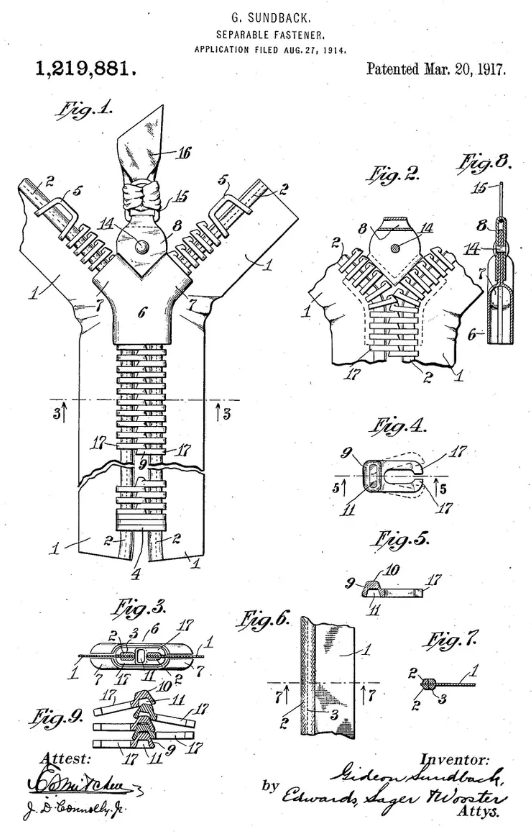
Which neatly illustrates the interrelated nature of invention, and the genius of the patent system. Mr. Allen’s solution to the Flag Day dilemma depended upon the earlier work of a Swedish electrical engineer, Gideon Sundback, inventor of the modern zipper:

Of course, Sundback was no doubt aided by Whitcomb Judson’s 1893 “Clasp Locker,” and Elias Howe, Jr.’s 1851 “Automatic, Continuous Clothing Closure.” And yes, this is the same Elias Howe who invented the sewing machine.

Happy Flag day and display your flags properly!