5 Star Background, 1 Star Patent

As we have said several times, the Background in a patent application is trap for unwary, and in general the less said the better.

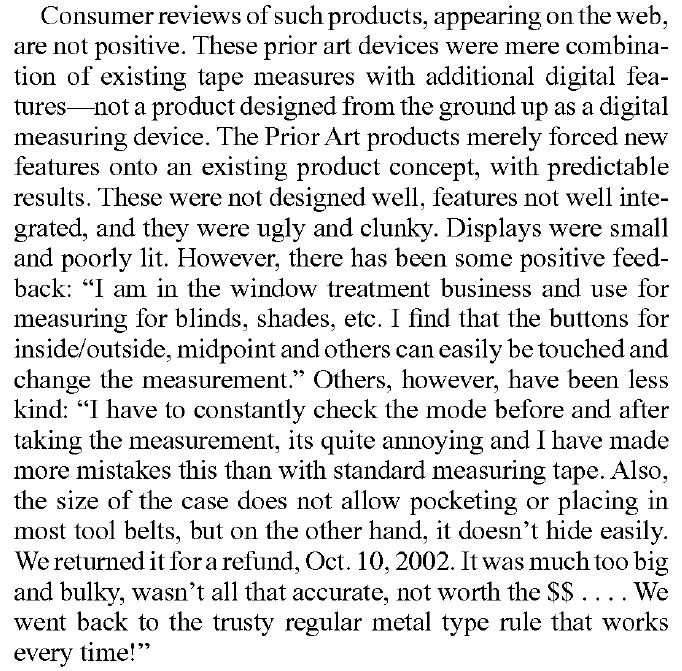
U.S. Patent No. 8,356,419 has an interesting take on the Background, relying on consumer reviews of the prior art:

Whether in the applicant’s own words or in the adopted words of consumer reviews, criticisms of the prior art can have a limiting effect on claim scope, because why would the inventor want to claim something that he or she criticized or believe in adequate?

It is unlikely that a Background section has ever worked to the benefit of a patent applicant, but there are multiple examples of where the Background has disadvantaged the applicant, whether through “admitted prior art” or limitation of the claims through criticism of the prior art.

The lesson remains, the less said, the better.

Another Milestone: Patent No. “About” 12,000,000

June 4, 2024, marked another USPTO milestone. U.S. Patent No. 12,000,000 issued. It had been just 1120 days since the issuance of U.S. Patent No. 11,000,000 on May 11, 2021. This was the second-shortest period of time for one million patents to issue — the shortest between the 1057 days between patent numbers 10,000,000 and 11,000,000, and a long way from the 27419 days (75+ years) between patent number 1 and 1,000,000.

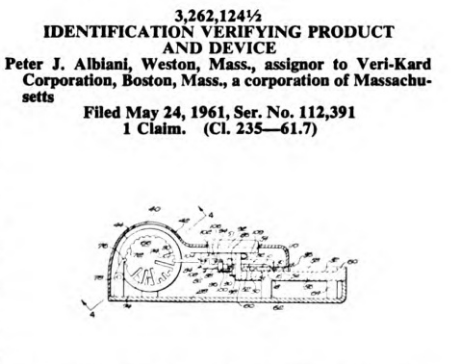
Of course,12,000,00 is not the exact number. Before U.S Patent No. 1 issued on July 13, 1836, the USPTO issued about 9,957 patents before it occurred to anyone to number them. We say “about” because a fire in the Patent Office destroyed records and the precise number of these X patents is not certain. Also, there are 70854 of patent numbers which for one reason or another, no patent issued. See, the list of these numbers here. There are also some patents with fractional numbers that bump the total (see our prior post about these patent oddities), including U.S. Patent No. 3,262,124 1/2:

Finally, we are only counting utility patents in the about 12,000,000, and not the approximately 1,030,182 design patents that have issued since 1843, or the approximately 35,860 plant patents that have issued since 1931, or reissue patents, or improvement patents — so called AI patents that issued between 1838 to 1861. Real Patent Number nerds will want to check out this list and the notes at the bottom

If recent history is a good guide, we should get to utility patent number “about” 13,000,000 sometime around Tuesday, June 29, 2027.

Google’s Products Infringe Because They Do What Google’s Website Said They Do

In Ecofactor, Inc. v. Google LLC, [2023-1101] (June 3, 2023), the Federal Circuit affirmed the the denial of Google’s motion for summary judgment that claim 5 of U.S. Patent No. 8,738,327 was invalid under 35 U.S.C. § 101; the denial of Google’s motion for judgment
as a matter of law of non-infringement of the ’327 patent; and the denial of Google’s motion for a new trial on damages.

The ‘327 patent relates to the operation of smart thermostats in computer networked
heating and cooling systems to reduce strain on the electricity grid during a period of expected high demand through adjustments to the user’s thermostat settings. The district court denied Google’s motion for summary judgment on Section 101, and submitted step two of the Alice inquiry to the jury, which found Google failed to meet its burden. Google filed a post-trial JMOL motion repeating its § 101 arguments, which the district court denied.

Google appealed the order denying summary judgment but not the jury verdict of ineligibility. The Federal Circuit said that the denial of Google’s motion for Summary Judgment was not appealable, disposing of the eligibility issue.

On the issue of infringement, the claims required a thermostat “that receives temperature
measurements from inside the structure.” Google argues that because metal, plastic, and/or glass housings, they cannot directly measure the surrounding ambient temperature “inside the structure” like other thermostats. Google argues that its thermostats can only derive an estimate of the ambient temperature by measuring only the temperature within the thermostat housing itself, which is not “inside the structure.” As a result, Google argues that the jury’s verdict of infringement is unsupported by substantial evidence.

EcoFactor’s infringement expert testified that the accused thermostat products meet
the claimed limitation because the thermostats measured temperature of the structure and not just the temperature within the thermostat housing. 26:20–327:6). EcoFactor’s expert supported his conclusion with several forms of evidence. EcoFactor’s expert relied on website guides maintained Google for the benefit of software engineers who develop applications for use with Nest thermostats. One website page states that the Nest thermostats measure the “[a]mbient temperature,” defined as the “temperature measured near the thermostat”—not just within the thermostat. Another website page explains that the temperature sensors of certain Nest products measure ambient room temperature.

The Federal Circuit concluded that the jury’s infringement verdict that the accused Nest thermostat products satisfy the claim language of “receives temperature measurements from inside the structure” is supported by substantial evidence.

On the issue of damages, Google argued for a new trial because EcocFactor’s damages expert should have been excluded. Among other things, Google asserted that his proposed royalty rate was “plucked . . .out of no where.” However the Federal Circuit said that far from plucking the $X royalty rate from nowhere, Mr. Kennedy based this rate on the following admissible evidence: three license agreements and the testimony of
EcoFactor’s CEO, Mr. Habib. Ultimately, the Federal Circuit noted, the jury returned a verdict of $20,019,300, which represents significantly less than Mr. Kennedy’s proposed damages amount of $Y that would have resulted from applying the $X royalty rate to Google’s past sales.

Google also attacked the lack of apportionment, since the licenses relied upon were for EcoFactor’s entire patent portfolio. The Federal Circuit explained that damages owed to the patentee must reflect the value of only the patented improvement—called apportionment. If a sufficiently comparable license is used for determining the appropriate reasonable royalty rate, further apportionment may not be required because the comparable license has built-in apportionment. Built-in apportionment effectively assumes that the negotiators of a comparable license settled on a royalty rate and royalty base combination embodying the value of the asserted patent.” Id. (citation omitted). For built-in apportionment to apply, the license must be sufficiently comparable in that principles of apportionment were effectively
baked into the purportedly comparable license. The Federal Circuit found that Mr. Kennedy sufficiently showed, for purposes of admissibility, that the three license agreements were economically comparable to the hypothetically negotiated agreement.

Judge Prost dissented from the damages portion of the opinion, stating that Google argues that (1) Mr. Kennedy, EcoFactor’s damages expert, calculated an $X royalty rate2 from the Schneider, Daikin, and Johnson lump-sum licenses in an unreliable way; and (2) the $X rate in any event did not reflect the value of the ’327 patent (as distinct from that of other patents covered by those licenses). Google is right on both counts. The district court therefore, in my view, abused its discretion by not granting a new damages trial given Mr. Kennedy’s flawed testimony.


    Decoration Day 2024

    Memorial Day was created in

    On May 5, 1868, General John A. Logan, commander-in-chief of the Grand Army of the Republic (GAR), an organization of and for Union Civil War veterans, issued a proclamation calling for “Decoration Day” to be observed annually and nationwide. This followed a practice begun in the Southern states two years earlier. Northern states quickly adopted the holiday.

    The name “Memorial Day,” first used in 1882, gradually became more common than “Decoration Day” after World War II as the holiday expanded to honor the fallen from the World Wars. However, it was not until 1967 that it was declared the official name of the holiday. A year later Congress passed the Uniform Monday Holiday Act, which moved Memorial Day from its traditional May 30 date to the last Monday in May, effective 1971.

    A few patents mention Decoration Day. U.S. Patent No. 972,371 issued October 11, 1910, to Walter Hammett, mentioned the holiday on a deck of cards for playing a card that that “will afford instruction as well as amusement. Oddly enough the next patent to mention Decoration Day was also on Playing Cards. U.S. Patent No. 1,703,754 issued on February 26, 1929, to Leo Smedley.

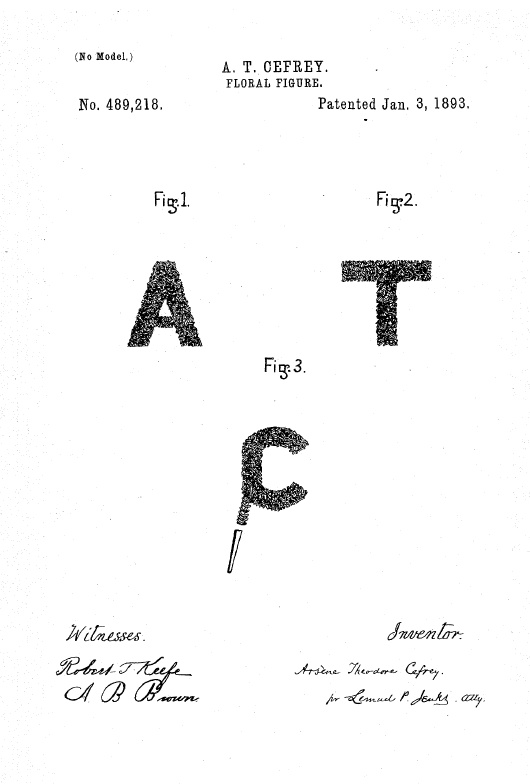
    It was not until 1893 that the first patent issued on a decoration for Decoration Day. U.S. Patent No. 489,218 issued to Arsine Cofrey on January 3, 1893 on a Floral Figure:

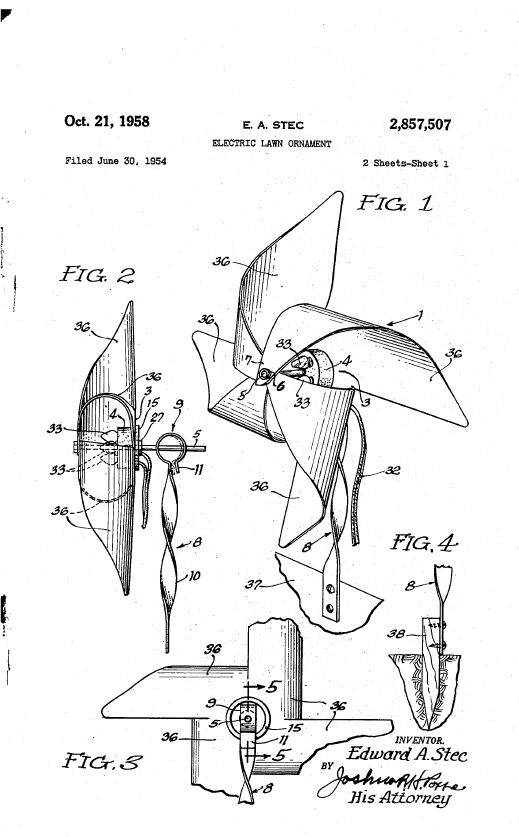
    It was not until 1958 that a second patent issued on a decoration for Decoration Day. U.S. Patent No. 2,857,507 issued October 21, 1958, to Edward Stec on an Electric Lawn Ornament:

    There are several patents that reference Memorial Day, but disappointingly most are about calendaring the day, or reference the 500 mile race in Indianapolis held on the day. See, for example, US Patent Nos. 3396810 and 3653459. Fixing the holiday to guarantee a long weekend seems to have distracted us for the true meaning of the holiday. Sure, have fun this holiday weekend, but don’t forget to remember those who made it possible for us to enjoy it.

    Aggregate Data is Not Enough to Show Domestic Industry in a Section 337 Proceeding.

    In Zircon v. ITC, [2022-1649] (May 8, 2024), the Federal Circuit Court affirmed the ITC determination of no violation of section 337. The case involved U.S. Patent Nos. 6,989,662, 8,604,771, and 9,475,185, on electronic stud finders.

    To establish a section 337violation, Zircon was required to show that “an industry in the United States, relating to the articles protected by the patent . . . exists or is in the process of being established.” 19 U.S.C. § 1337(a)(2). This is referred to as the “domestic industry” requirement. The ALJ found that the economic prong of the domestic industry requirement was not satisfied with respect to any of the asserted patents. The Commission upheld the ALJ’s determination that there was no violation of section 337, for two independent reasons. First, with respect to the domestic industry requirement, the Commission affirmed the ALJ’s determination that Zircon had not satisfied the economic prong of that requirement. Second, the Commission found each of the claims of the ’662, ’771, and ’185 patents that were before the Commission were either invalid or not infringed.

    To meet the domestic injury requirement, a complainant can show that, “with respect to the articles protected by the patent,” there is “(A) significant investment in plant and equipment; (B) significant employment of labor or cap-ital; or (C) substantial investment in its exploitation, including engineering, research and development, or licensing.” 19 U.S.C. § 1337(a)(3)(A)–(C). That provision is referred to as the “economic prong” of the domestic industry requirement.

    Zircon has relied on evidence of its cumulative expenditures on all 53 of its domestic industry products to argue that its investments in plant and equipment, labor or capital, and/or research and development have been significant or substantial. Zircon had acknowledged, however, that not all 53 products prac-tice all three of the asserted patents. Rather, Zircon’s evidence showed that of the 53 products, 14 practice all three of the asserted patents; 21 practice both the ’771 and ’185 patent; 16 practice only the ’662 patent; and two practice only the ’771 patent. Zircon did not allocate its expenditures on its 53 stud finder products separately with respect to each of its products or each of the asserted patents. The Commission found that Zircon’s failure to do such an allocation precluded the Commission from evaluating the significance of Zircon’s investments with respect to each asserted patent.

    On appeal, Zircon argued that the Commission erred by requiring a patent-by-patent breakdown of its investments and that, in doing so, the Commission departed from its “flexible, market-oriented approach to domestic industry” in Certain Wireless Devices with 3G and/or 4G Capabilities & Com-ponents Thereof, Inv. No. 337-TA-868, USITC Pub. 4475, Initial Determination at 413 (July 29, 2013).

    The Federal Circuit found the ITC actions were consistent with Federal Circuit precedent, noting that it has held that where a party seeks to rely upon research and development activities, it must show that those activities the complainant must show that those activities “pertain to products that are covered by the patent that is being asserted.” The Federal Circuit explained that “[i]n cases in which all the domestic industry products practice all the asserted patents, it follows from the language of section 337 and our case law that the complainant could satisfy the economic prong as to all asserted patents based on the entire product group. But in cases in which the complainant’s products or groups of products each practice different patents, the complainant would need to establish separate domestic industries for each of those different groups of products.”

    Zircon further argued that in a case such as this one, the Commission’s analysis should proceed on the basis that there is a single industry which exploits the patents. But the Federal Circuit distinguished ZIrcon’s precedent because Zircon sought to aggregate were not all protected by the same patent or patents. The Federal Circuit noted that Zircon might have been able to show the substantial or significant investment requirement was met by its investment in the 14 products that practice all three asserted patents, but Zircon provided no way for the Commission to assess the significance of Zircon’s investment in that product group because Zircon presented its investments in the aggregate for all 53 products, which practiced multiple different combinations of patents.

    Because it upheld the Commission’s ruling on the domestic industry issue, the Federal Circuit said it was unnecessary for it to reach Zircon’s challenges to the Commission’s infringement and invalidity rulings.

    Posted in ITC

    Exemplary Claiming, Not Exemplary Claims

    When drafting claims it is permissible to use exemplary language (“for example” or “such as”). According to MPEP 2173.05(d) use of such language “does not by itself render the claim indefinite,” although the section then rattles off five examples where exemplary language was found to be indefinite. Even if exemplary language is permissible, is it a good idea?

    Modern patents occasionally issue with claims containing exemplary language. Consider claim 14 of U.S. Patent No. 11972683:

    14. The tracking arrangement as claimed in claim 13, wherein the “cooperative awareness message <CAM>” has the following vehicle-specific, vehicle-characteristic message parameters: type of different vehicles belonging to the road users, for example bus, automobile, motorcycle, etc., in the group; time stamp of vehicles belonging to the road users in the group should be close in terms of time; position of different vehicles belonging to the road users in the group should be adjacent; direction of vehicles belonging to the road users in the group should be the same; speed of vehicles belonging to the road users in the group should be comparable; length of different vehicles belonging to the road users is used as a group identifying feature; width of different vehicles belonging to the road users is used as a group identifying feature; issuing authority of the cryptographic certificates for the signature of the status messages; certificate hierarchy for validating the certificate for the signature of the status messages; repetition rate of the change of the parameters.

    What do the examples do for this claim? Does the absence of “trucks” is the list affect the meaning of “type of different vehicles”?

    What about claim 11 of U.S. Patent No. 11965836:

    11. The detection assembly as claimed in claim 10, wherein the matrix array of light-emitting diodes is made of a longitudinal succession of strips of LED tape which are secured, for example glued, transversely to the inner surface.

    Does “glued” affect the meaning of “secured”? There is a presumption that every word in a claim is to be given meaning, so what does “glued” for claim 11.

    Then there are claims structured like claim 13 of U.S. Patent No. 11965415:

    13. The method as claimed in claim 1, wherein the injected current comprises an alternating current signal having a frequency of 1 Hz or lower, for example 0.5 Hz or lower, or 0.25 Hz or lower.

    Does the claim cover all frequencies below 1Hz? What is the significance of 0.5 Hz? Of 0.25 Hz?

    While claims can include exemplary language, it may not result in exemplary claims.

    Cinco de Mayo, Dos Mil Veinticuatro

    Cinco de Mayo, also known as Battle of Puebla Day, is a holiday celebrating the date of the Mexican Army’s May 5, 1862, victory over France at the Battle of Puebla during the Franco-Mexican War. Although hostilities continued for five more years, General Ignacio Zaragoza success represented a great symbolic victory for the Mexican government and bolstered the resistance movement.

    A minor holiday in Mexico, it is more widely celebrated in the United States, and most U.S. celebrations feature margaritas. Like most things involving tequila, the origin of the margarita is unclear. Some claim that the margarita is a variation of the brandy daisy, remade with tequila instead of brandy. Others claim that the margarita was invented in 1938 by Carlos “Danny” Herrera the Rancho La Gloria restaurant in Baja California. Still other claims that the margarita was in 1938 by a bartender in honor of Mexican showgirl Rita de la Rosa. Still others claims that it was invented in Ensenada, Baja California, in 1941 by bartender Don Carlos Orozco. There are also claims that the margarita was first mixed in Juárez, Chihuahua, at Tommy’s Place Bar on July 4, 1942, by Francisco “Pancho” Morales.

    Whatever its origins, margaritas are a popular cocktail, and the drink of choice on Cinco de Mayo, so it is not surprising that a bit of technology has been developed around the margarita.

    Tools

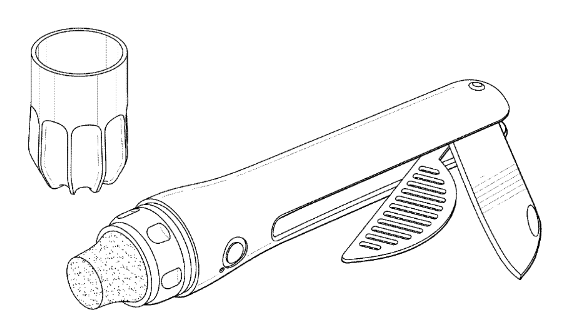
    U.S. Patent No. D743217 protects the appearance of a margarite tool:

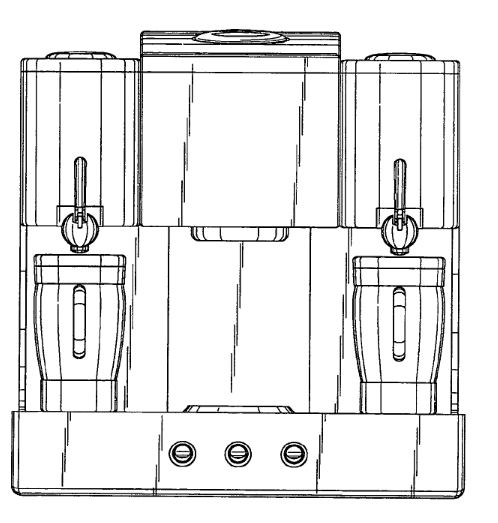
    U.S. Patent No. D566452 protects the appearance of a Margarita Maker:

    Glassware

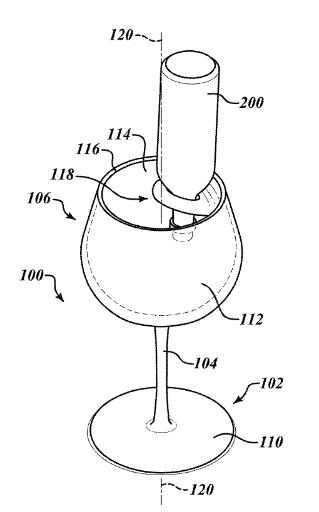
    U.S. Patent No. 11,033,131 protects the glass for serving a bottle of beer:

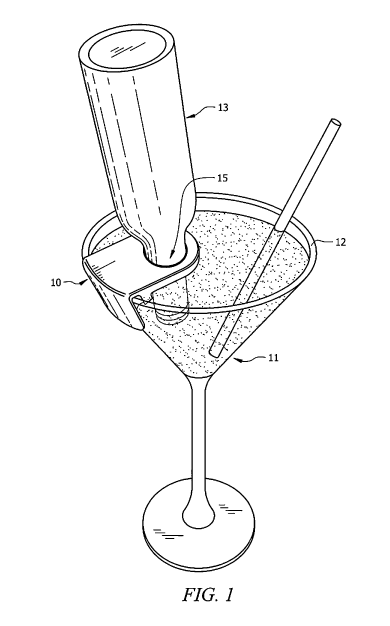
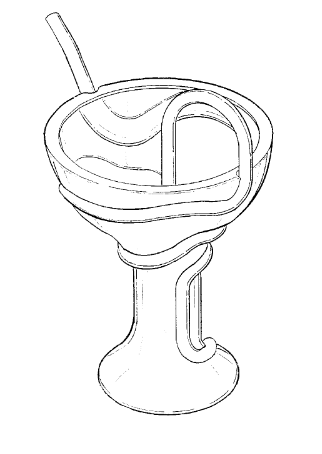
    U.S. Patent No. similarly protects a device for serving a margarita with a bottle of beer:

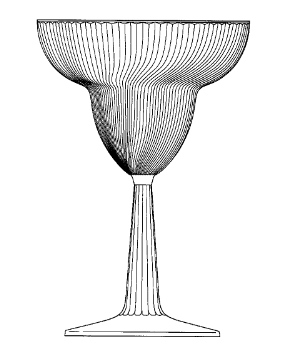
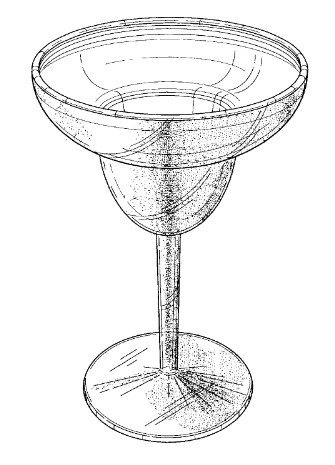
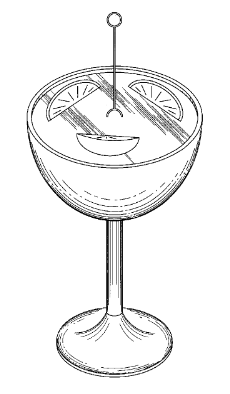
    U.S. Patent No. D540120 protects the appearance of a Margarita Glass:

    U.S. Patent No. D454758 also protects the appearance of a Margarita Glass:

    U.S. Patent No. D453093 also protects the appearance of a Margarita Glass:

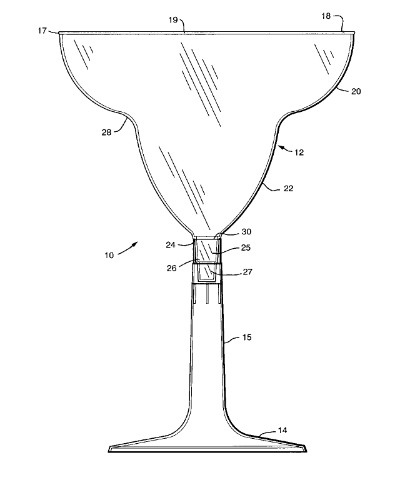
    U.S. Patent No. 5842590 protects a Nestable Margarita Glass Apparatus and Method:

    Margarita-Themed Products

    U.S. Patent No. D545005 protects the appearance of a Margarita-styled Bird Feeder:

    May the 4th be wIth You

    Happy Star Wars Day. What better way for a patent lawyer to celebrate than with a collection of Star Wars patents?

    Vehicles

    • D254080 Toy Spacecraft (X-Wing Fighter)
    • D254081 Toy Spacecraft (TIE Fighter)
    • D257160 Aerial Toy (Landspeeder)
    • D265668 Toy Space Vehicle (Twin-Pod Cloud Car)
    • D266777 Toy Vehicle (AT-AT)
    • D267025 Toy Space Vehicle (Snowspeeder)
    • D268192 Toy Space Vehicle (Rebel Transport)
    • D268200 Toy Space Vehicle (TIE Bomber) –
    • D268773 Toy Space Vehicle
    • D271780 Toy Space Vehicle (Rebel Medical Frigate)
    • D277116 Toy Vehicle (Imperial Shuttle)
    • D277120 Toy Vehicle (Tatooine Skiff)
    • D277200 Toy Spacecraft (A-Wing)
    • D277201 Toy Spacecraft (B-Wing)
    • D277398 Toy Vehicle (Speeder Bike)
    • D277493 Toy Vehicle (Sail Barge)

    Characters

    Weapons

    • D256485 Toy Sword (Light Sabre))
    • D259578 Toy Helmet (Helmet)
    • 10065127 Sword Device with Retractable, Internally Illuminated Bllade

    April 22, 2024, The 55th Earth Day

    The first Earth Day was April 22, 1970, it was not until 20 years later, that the impact of Earth Day was recorded in the U.S. Patent collection. In U.S. Patent No. 5090559, issued in 1992 on Reusable Garment Bags for Dry Cleaning, acknowledged that ” ‘Earth day,’ citizen activist groups, scientists and a large number of television documentaries and public information and service programs have all increased public awareness of [issues with disposable bags.”

    In 1997, U.S. Patent No. 5601204 on a Tank Vault With Sealed Liner, noted:

    Since the 1970s, the world, and in particular, the United States, has been concerned with the environment and the contamination of that environment, including the earth’s soil, its atmosphere and its water. The first Earth Day in 1970 resulted in the eventual creation of the Environmental Protection Agency by the United States Congress.

    Since the 1970s, the world, and in particular, the United States, has been concerned with the environment and the contamination of that environment, including the earth’s soil, its atmosphere and its water. The first Earth Day in 1970 resulted in the eventual creation of the Environmental Protection Agency by the United States Congress.

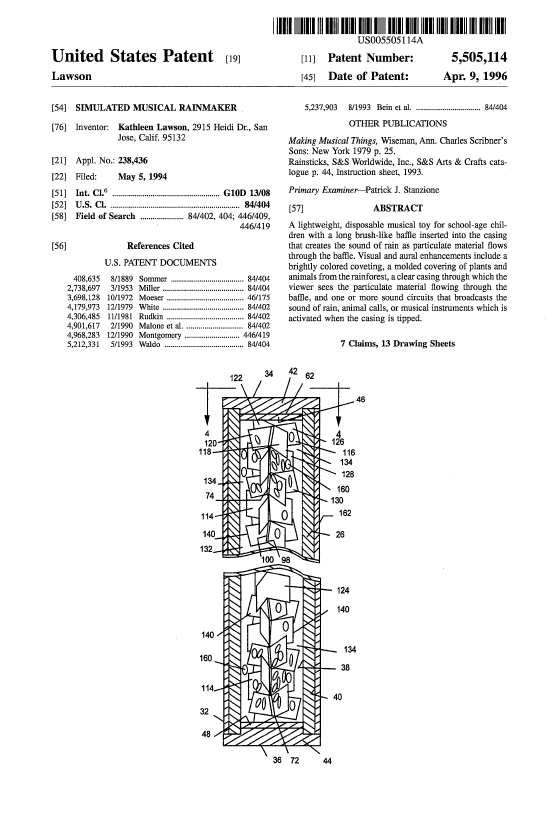
    U.S. Patent No. 5595114 issued in 1996 on a Simulated Musical Rainmaker, which it described as “a perfect toy to celebrate Earth Day, which is slowly becoming an important holiday in the calendar year.”

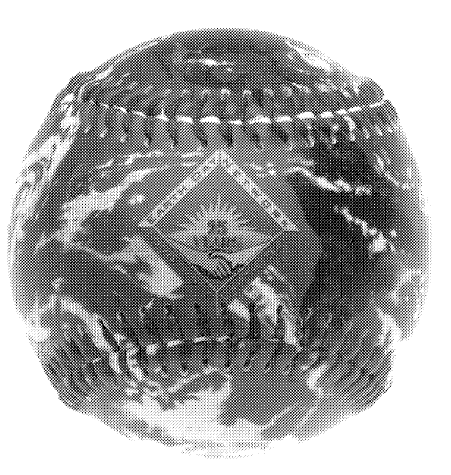
    U.S Patent No. D407127 issued on a baseball with an Earth Day logo:

    U.S. Patent No. 7560822 issued in 2009 on an Educational Electrical Generation Kit that is “sturdily and durably configured, particularly since it may be used in crowded environments with children present (e.g., in schools, science fairs, Earth Day events, open houses at utility companies, museums, etc.).”

    U.S. Patent Nos. 8870061 issued in 2014 and 9302818 issued in 2016 disclose a Reusable Envelope, which the patents indicate is particularly adapted for Earth Day mailings.

    U.S. Patent No. 10107029, issued in 2018, commented that “forty years after capturing the imagination of many people during the first observance of Earth Day, America’s recycling revolution is getting mixed reviews.” While the patent noted that “140 million Americans recycle—more than vote in national elections,” we can certainly do better, and as the 55th Earth Day approaches, hopefully, we will.  

    Reasonable Expectation of Success Made Claims Obvious

    In Salix Pharmaceuticals. Ltd v. Norwich Pharmaceuticals Inc., [2022-2153, 2023-1952] (April 11, 2024), the Federal Circuit affirmed the district court determination that Norwich infringed claim 8 of U.S. Patent 8,624,573, claim 6 of U.S. Patent 9,421,195, and claims 11
    and 12 of U.S. Patent 10,335,397 and had failed to prove that those claims were invalid.

    Rifaximin, the active ingredient in Salix’s commercial product Xifaxan®, has been widely used as an antibiotic for decades, having been first synthesized in the early 1980s
    in Italy and approved there as an antibiotic in 1985. The FDA approved Xifaxan nearly 20
    years later, in 2004, as 200 mg tablets for the treatment of travelers’ diarrhea. The FDA subsequently approved 550 mg tablets for hepatic encephalopathy in 2010 and for irritable bowel syndrome with diarrhea (“IBS-D”) in 2015.

    Norwich sought to market a generic version of rifaximin and, in 2019, filed an ANDA for 550 mg tablets with the same indications as Xifaxan, certifying pursuant to 21 U.S.C. § 355(j)(2)(vii)(IV) that Salix’s rifaximin patents were invalid. Salix timely sued, asserting that Norwich’s
    ANDA infringed dozens of valid, Orange Book-listed patents. By the time of trial, the case had been streamlined to three groups of patents:

    1. the ’573, ’195, and ’397 patents, directed to treating hepatic encephalopathy
    2. the ’569 and ’667 patents, directed to treating irritable bowel syndrome with diarrhea with 550 mg rifaximin three times a day (1,650 mg/day) for 14 days; and,
    3. the ’199 and ’206 patents, directed to rifaximin form β

    Following a bench trial, the district court held that Norwich infringed the hepatic encephalopathy patents’ claims and had failed to establish their invalidity. Norwich did not appeal those holdings. The court also held that Norwich’s ANDA infringed the irritable bowel syndrome and polymorph patents, but that those patents’ claims would have been obvious
    over the prior art. Salix appealed those invalidity holdings.

    Norwich then amended its ANDA in an attempt to remove the infringing hepatic encephalopathy indication and moved to modify the judgment under Federal Rule of Civil Procedure 60(b), asserting that the amendment negated any possible infringement. The court denied Norwich’s motion, and Norwich cross-appealed.

    Validity of the Irritable Bowel Syndrome Claims

    The key limitation on appeal is the dosage amount that appears in the claims: 550 mg, three times per day (“TID”), for a total of 1,650 mg/day. Norwich challenged the IBS-D claims’ validity by asserting as prior art references a clinical trial protocol that had been published and a 2006 journal article by Pimentel. The Protocol described a Phase II study evaluating
    twice-daily doses of 550 mg (1,100 mg/day) and 1,100 mg (2,200 mg/day) for 14 and 28 days for the treatment of irritable bowel syndrome. Pimentel taught administering 400 mg, TID (1,200 mg/day), for the treatment of irritable bowel syndrome but further opines that the “optimal dosage of rifaximin may, in fact, be higher than that used in our study.” The district court found that those two references disclose each and every limitation of the challenged irritable bowel syndrome claims, and further found that a skilled artisan would have been motivated to combine those two references to arrive at what is claimed with a reasonable expectation of success.

    Salix appealed, asserting that the court erred in finding that a skilled artisan would have had a reasonable expectation of success in using the claimed 1,650 mg/day dosage to treat irritable bowel syndrome. According to Salix, the highest prior art dosage amount
    that could have been supported with a reasonable expectation of success was the 1,200 mg/day dose evaluated by Pimentel. The Federal Circuit disagreed, noting that while the Protocol alone might not support the reasonable expectation of success, in combination with Pimentel, which taught that “[r]ecent data suggest that the optimal dosage of rifaximin may, in fact, be higher than that used in our study,” it was not error for the district court to conclude that there was a reasonable expectation of success as to the efficacy of 550 mg TID dosing.

    Validity of the rifaximin form β Claims

    Norwich challenged the polymorph claims’ validity by asserting, inter alia, Cannata, which discloses that rifaximin exists in crystalline form with “outstanding antibacterial properties.”

    The district court held that expert testimony supported a conclusion that, in view of the prior art, (1) a skilled artisan would have had good reason to characterize the crystalline
    rifaximin obtained by following the Cannata protocols, (2) that such characterization was routine and could have been performed “in one day,” and (3) that doing so would have led the skilled artisan to have “detected rifaximin β.”

    The Federal Circuit noted that the scope and content of the prior art here includes preparations of crystalline rifaximin, which expert testimony supports would have yielded the β form of rifaximin. The difference between the prior art and the claims is thus effectively nothing more than the performance of routine characterization to identify the polymorphic forms that result from the known Cannata processes.

    Salix argued that the rifaximin’s β form nonetheless constituted a non-obvious invention because, although skilled artisans actually succeeded in producing and characterizing it, they would not have expected to succeed because, as of the critical date, the polymorphic nature of rifaximin had not yet been reported and the identity of the β form remained undisclosed. Salix further argues that there could have been no expectation of success because the skilled artisan would not have been able to predict what polymorphic forms might result from following the preparation protocols disclosed in the prior art. The Federal Circuit disagreed, noting that Salix has done no more than combine known elements of the prior art to verify readily accessible information concerning a compound already in the hands of those of ordinary skill in the art, and such routine efforts do not justify removing this polymorph from the public domain.

    The Federal Circuit noted that it was not holding that there is always a reasonable expectation of success in accessing or characterizing polymorphs. It was simply reviewing the district court’s decision before it as to its factual finding of a reasonable expectation of success, and in so doing, have not been left with a definite and firm conviction that a mistake was made in reaching that finding.

    Norwich’s Cross Appeal

    On cross-appeal, Norwich raises two related but distinct arguments that arose after the district court held that Norwich infringed the HE patents and failed to establish invalidity. Norwich first argues that the district court misinterpreted 35 U.S.C. § 271(e)(4)(A), which directs a court, following a finding of infringement, to order the FDA to defer final approval of an ANDA until the expiration of the infringed patent. According to Norwich, that statute precludes delaying final approval of an entire ANDA, and instead requires delaying only the approval of the infringing use.

    The Federal Circuit said Section 271(e)(4)(A) instructs that, following a finding of infringement, “the court shall order the effective date of any approval of the drug or veterinary biological product involved in the infringement to be a date which is not earlier than the date of the expiration of the patent which has been infringed.” Norwich argued that the language of § 271(e)(4) requires courts to tie the restriction on FDA approval to the
    indication for which the ANDA seeks approval when that indication was the source of infringement. The district court order concerned only the specific ANDA in question that included an infringing use, referred to the ANDA by its number, and enjoined the approval
    of that ANDA.

    Since the FDA does not approve drugs in the abstract, but rather approves drugs for particular uses (indications) of that drug, the statute is appropriately construed as directed to approval of particular infringing uses of the drug, not all uses of the drug including non-infringing uses. The statutory scheme makes clear that the relevant infringement is the submission of the ANDA that included an infringing use. That the ANDA further recited a non-patent-protected indication does not negate the infringement resulting from the ANDA’s submission. The order thus appropriately delayed the effective final approval date of “this
    infringing ANDA” submission.

    Norwich’s second argument arises from its decision to amend its ANDA to carve out the infringing HE use after final judgment. Following that amendment, Norwich filed a motion to modify the final judgment to allow for prompt approval of the amended ANDA that purportedly no longer sought approval for the infringing HE use. The district court denied that motion, holding that Norwich “fully litigated the merits of its non-infringement and invalidity case, lost, and now seeks a way around the final judgment through Rule 60(b).

    The Federal Circuit said that a district court may reconsider its own finding of infringement
    in light of an amended ANDA, but the court need not do so, and the Federal Circuit said that the court reasonably held that consideration of the amended ANDA would be inequitable
    and inappropriate. The court noted that it is not a simple matter to determine whether an
    ANDA applicant has successfully carved out language from a label to turn infringement into non-infringement” and that what Norwich sought in its Rule 60(b) motion would essentially be a second litigation” following final judgment.

    .