On February 28, 1893, Edward G. Acheson received U.S. Patent No. 492,767 on the Production of Artificial Crystalline Carbonaceous Materials (silicon carbide):
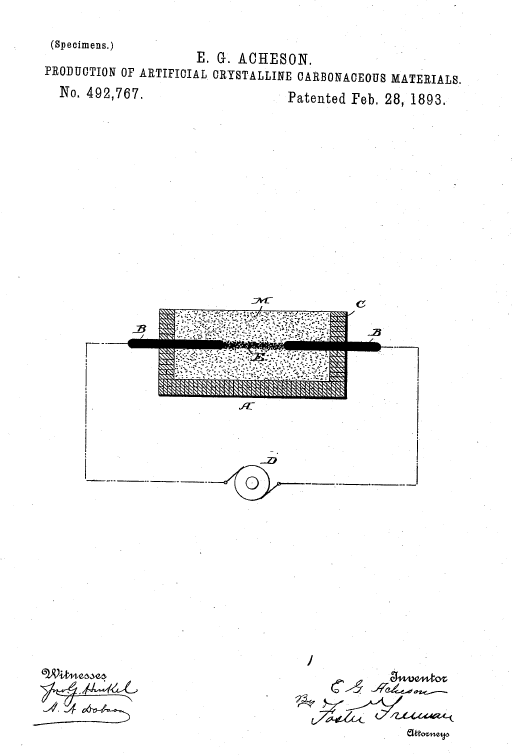
Edward Acheson worked with Thomas Edison before setting up his own lab, where he began a search for an industrial abrasive. While attempting to make artificial diamond, he heated a mixture of carbon and clay, and found that the mixture small blue crystals he named carborundum, believing them to be a carbonized form of corundum. He later found out the material was silicon carbide. In 1894, he started the Carborundum Company in Monongahela, Pennsylvania, to produce grindstones, knife sharpeners, and various abrasives. Two years later, on May 19, 1896, obtained a patent for an electric furnace suitable for making carborundum Electrical Furnace (U.S. Patent No. 560,291). Two years after that, on December 6, 1898, he obtained a patent for an improved article of carborundum (U.S. Patent No. 615,648). In 1926, the U.S. Patent Office named carborundum as one of the 22 patents most responsible for the industrial age.
In the mid 1890s, Acheson discovered that overheating carborundum produced almost pure graphite — a useful lubricant. On September 29, 1896, he obtained U.S. Patent No. 568323 on the Manufacture of Graphite.
Acheson was central to establishing at least five industrial corporations, along the way receiving a total of 70 patents.