February 6, 2025

During the 139th celebration of Groundhog Day on Gobbler’s Knob in Punxsutawney, Pa., last Sunday, February 2, 2025, Groundhog Club handler A.J. Dereume announced that Punxsutawney Phil has forecast six more weeks of winter. Fortunately, on February 6, 1877, William Tell Steiger received U.S. Patent No. 186962 on a Foot-Warmer that might make these 42 additional days of winter a little more comfortable:

William Tell’s invention, which he called “Pedal Calorification” aims at economizing and utilizing the wasted heat in warm breath using “any simple contrivance for conveying it to our feet, where it is so much needed.”

William Tell Steiger was born on April 10, 1801, He lived in Howard County, Maryland in the 1860’s and 1870’s, and died on September 21, 1888, in Laurel, Maryland, and is buried in Oak Hill Cemetery, Washington, D.C.

February 5, 2025

On February 5, 1929, G. T. Bresnehan received U.S. Patent No. 1,701,026 on a Foot Support (a starting block for track runners):

G.T. Bresnahan was a successful athlete at Sterling and the University of Wisconsin-Madison before becoming a highly successful collegiate (Iowa Hawkeyes) and Olympic Coach. In addition to the adjustable starting block in the ‘026 patent, he received a nother patent (2144962) ten years later on another adjustable starting block:

and a patent (2,223,091) on a rubber-edged discuss.

Bresnahan and his discus co-inventer W.W. Tuttle literally wrote the book on track and field athletics:

February 4, 2025

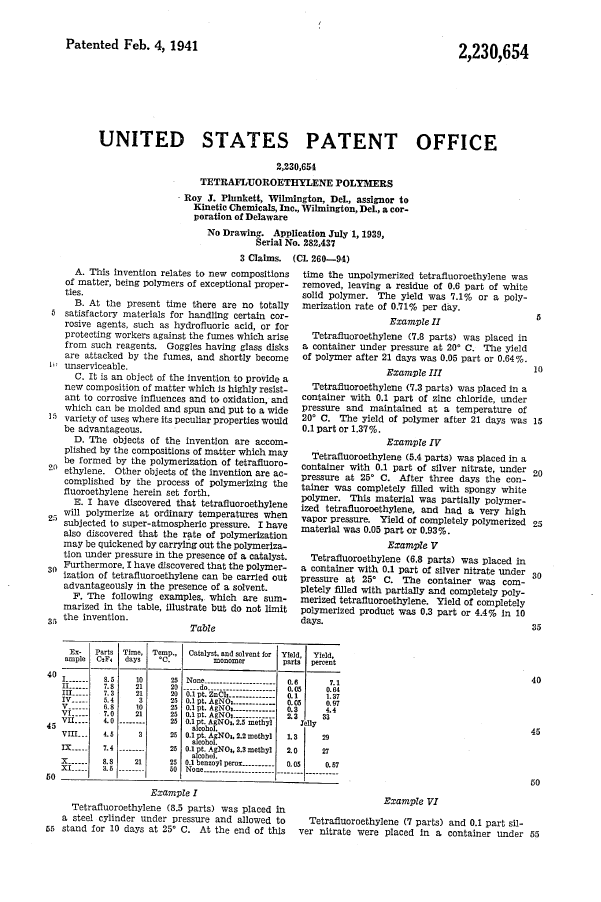
On February 4, 1941, Roy J. Plunkett received U.S. Patent No. 2,230,654, on Tetrafluoroethylene, assigned to his employer Kinetic Chemicals, Inc.:

Plunkett had earned a PhD in chemistry, but his discovery of Teflon was largely by accident. Plunkett was working in a laboratory in Edison, New Jersey, in 1938 trying to find alternative chlorofluorocarbon refrigerants. He and his assistant made about 100 pounds of Tetrafluoroethylene (TFE), a common precursor of refrigerants. They froze the TFE in a gas cylinder, but the next day no gas came out. They opened the cylinder and found that the TFE had polymerized into a white powdery substance.

Plunket studied the powdery substance further and found its properties to be waxy, very slippery, chemically stable and had a high melting point. DuPont went to work on the new polymer, and by 1941 it had found numerous applications, and given a new name -Teflon.

Teflon became so well known for its slipperiness, that it found use in in common parlance, President Ronald Reagan being dubbed the “Teflon President,” and John Gotti, being called the “Teflon Don.”

January 30, 2025

On January 30 James Ritty and John Birch received U.S. Patent No. 271,363 on a Cash Register

James Ritty was a saloon keeper concerned that some of his some of his employees were skimming customers’ money meant to pay for food and drink. On a cruise he noticed a machine that counted rotations of the ship’s propeller, and thought something similar could be used to track cash transactions back at his saloon.

James enlisted the help of his brother John, a skilled mechanic, and the brothers began working on a design for such a device. After several failed prototypes, they created their third design, operated by pressing a key that represented a specific amount of money. There was no cash drawer. James and John Ritty patented the design on November 4, 1879, as “Ritty’s Incorruptible Cashier”:

The Rittys opened a small factory to make cash registers while continuing to operate the saloon. The company was not prospering and James Ritty his interest in the cash register business to a group of investors who formed the National Manufacturing Company, which was eventually renamed the National Cash register Company.

January 29, 2025

On January 29, 1924, Carl R. Taylor received U.S. Patent No. 1,481,813 on an [Ice Cream] Cone Rolling Machine:

Carl allegedly attended the 1904 World’s Fair in St. Louis, where he became fascinated with ice cream and the ice cream cone. He returned to Cleveland and spent nearly two decades developing a machine to quickly and cheaply make ice cream cones. Although his was not the first cone rolling machine (that honor goes to H.G. Tatosian’s U.S. Patent No. 1,440,851, issued January 2, 1923, which was filed just five days before Carl’s filing date):

Shortly after his patent issued, Carl formed the Ice Cream Cone Company to manufacture the cones. Eventually the Ice Cream Cone Company was acquired by Norse Dairy Systems.

January 27, 2025

On January 27, 1880, Thomas Edison received U.S. Patent No. 223,898 on an Electric-Lamp

Edison’s patent was enforced against infringers, and its validity affirmed by the Second Circuit Court of Appeals in Edison Electric Light Co. v. United States Electric Lighting Co., 52 F. 300 (2nd Cir. 1892).

January 26, 2025

On January 26, 1875, George F. Green received U.S. Patent No. 159028 on an Electro-Magnetic Dental Tool (drill):

Green was a Kalamazoo, Michigan, inventor and dentist. His dental drill had an electromagnetic motor in it that operated by a rotating fan wheel that was controlled by a foot pedal.

Green was an amazingly prolific inventor earning at least 20 patents, the last few of which issued after his 1892 death: 236577, 238678, 260093, 265060, 277709, 338150, 338224, 338663, 381127, 386314, 388859, 390293, 432999, 465432, 465407, 473188, 504977, 506492, and 507493.

January 25, 2025

On January 25, 1870, Gustavus Dows received U.S. Patent No. 99170 on a Soda Fountain:

Gustavus D. Dows, the youngest of a 21-child family from Billerica, ran a drugstore with his brother at 213 Central Street in Lowell in the mid-1850s. He spent his days serving shaved ice lemonade to his customers, laboriously pulling a block of ice from an ice box each time and set to shaving with a hand planer it to make each drink. He spent his nights trying to come with a better way to make his shaved ice drinks, eventually inventing a dispenser that shaved ice and then automatically mixed it with syrup and cream.

Dows patented his invention and moved to Boston’s Washington Street, where business boomed. Not only did he sell more and more ice cream sodas, but he also sold his patented soda fountains. The New York Times wrote that Mr. Dows was the first to create a fountain that “looked like a Doric temple.”

January 24, 2025

On January 24, 1871, Charles Goodyear, Jr., (son of the inventor of vulcanization of rubber) received U.S. Patent No. 111,197 on a Machine for Sewing Boots and Shoes:

This was one of a series of seven patents that issued for machinery to make the famous Goodyear welt. U.S. Patent Nos. 96944, 112802,113420, 116947, 140035, and 143237, culminating with U.S. Patent No. 170547. A welt is a strip of material (e.g., leather, rubber, or plastic) extending the perimeter of a shoe outsole. The Goodyear welt machinery was actually based on a welt machine patented by August Destouy (U.S. Patent No. 143237) in 1862.