About bwheelock

Education J.D., Washington University in St. Louis B.S.E. in Mechanical Engineering, Duke University

It Ain’t Over ‘Till It’s Over

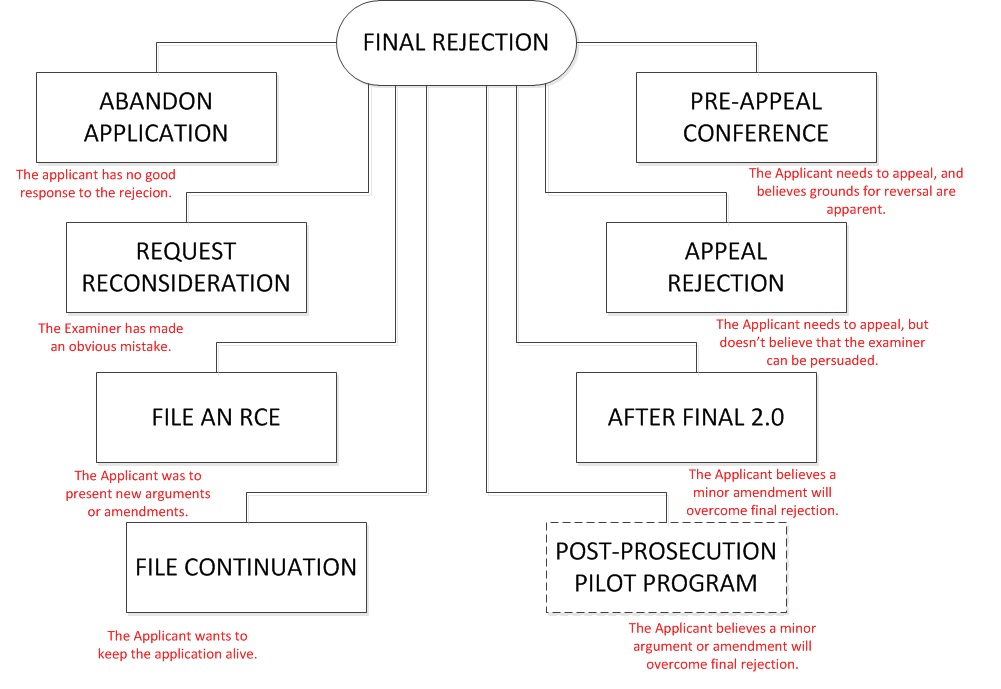
It seems that the majority of patent applications, including those that eventually issue as patents, face a “final” rejection at some point.  However, “final” does not not always mean final, and there are at least eight possible responses to a final rejection.
FINALREJECTION

ABANDON APPLICATION

As much as patent prosecutors hate to admit it, every once in a while the Patent Examiner is right, and the only reasonable response to the Final Office Action is to abandon the application.

REQUEST RECONSIDERATION/AMENDMENT AFTER FINAL

Sometimes a Final Office Action will be premised on an a clear mistake of law or fact, which if pointed out the the Examiner, will result in the withdrawal of the finality of the action, and perhaps even an allowance.  37 CFR §§1.113 and 1.116 address responses after a Final Office Action.   37 CFR §1.116 limits amendment to three situations:

  1. An amendment may be made canceling claims or complying with any requirement of form expressly set forth in a previous Office action
  2. An amendment presenting rejected claims in better form for consideration on appeal may be admitted; or
  3. An amendment touching the merits of the application or patent under reexamination may be admitted upon a showing of good and sufficient reasons why the amendment is necessary and was not earlier presented.

Generally, an Examiner will not permit an amendment unless it complies with 37 CFR §1.116.  Examiners have no incentive to give any substantial attention to a response after final, and they are rarely effective unless they fully comply with the requirements set forth in the Final Rejection.

FILE A REQUEST FOR CONTINUED EXAMINATION (RCE)

If an applicant wants to continue to prosecute the application, presenting additional arguments and evidence, or amending the claims, then the applicant can request continued examination under 37 CFR §1.114.  If an applicant timely files a submission and fee set forth in §1.17(e), the Office will withdraw the finality of any Office Action and the submission will be entered and considered.

RCE’s are a significant part of patent prosecution.  USPTO Statistics show taht approximately 30% of the applications waiting examination are applications in which an RCE has been filed:

RCEFILING

The USPTO treatment of RCE’s has changed over time — in 2009 the USPTO changed the Examiner’s incentives to handle RCE, which resulted in a large backlog, but various changes in USPTO policies have resulted in a steady decline in pendency. RCE

FILE A CONTINUATION APPLICATION

An application is always free to restart the application process by filing a continuation application.  Unlike an RCE which keeps its original serial number and filing date, a continuation application is a new application, which is assigned a new serial number and filing date (although it claims priority to the parent application).  Continuation applications are put at the bottom of the examination pile, and are a good choice for an applicant who wants to keep the application alive, but is not in a position to provide a complete response to the final rejection, which would be required to file an RCE.

AFTER FINAL 2.0

Although a response after final generally won’t be considered, several years ago the USPTO created an After Final Consideration Pilot 2.0 that gives Examiner a limited additional amount of time (and thus an incentive) to consider compliant submissions under the pilot program.  The current version of the program, which expires September 30, 2016, requires that the applicant file:

  1. A request for consideration under AFCP 2.0 (Form PTO/SB/434); and
  2. A response under 37 CFR 1.116, including an amendment to at least one independent claim that does not broaden the scope of the independent claim in any aspect.

In response to the AFCP submission, the applicant will receive an AFCP 2.0 response form (PTO-2323) that communicates the status of the submission. If the applicant requested an  interview, the the form will also be accompanied by an interview summary.

One can request an examiner interview after final in the ordinary course, but it is up to the discretion of the examiner as to whether to grant that interview request. Here, under the AFCP 2.0 program, the examiner is given additional time to search and/or consider the response, but also it gives applicants an additional opportunity to discuss the application with the examiner, if the response does not place the application in a condition for allowance. To date, the USPTO has not published statistics on the AFCP 2.0 program.

POST-PROSECUTION PILOT PROGRAM (P3) 

A new alternative for patent applications beginning July 11, 2016, and extending to January 12, 2017, is the Post-Prosecution Pilot Program or P3 Program.  The P3 Program provides for (i) an after final response to be considered by a panel of examiners (like the Pre-Appeal Brief Conference), (ii) an after final response to include an optional proposed amendment (like the AFCP 2.0), and (iii) an opportunity for the applicant to make an oral presentation to the panel of examiners (new).

The request for the P3 Program should include:

  1. A transmittal form, such as form PTO/SB/ 444, that identifies the submission as a P3 submission and requests consideration under the P3 Program
  2. A response under 37 CFR 1.116 comprising no more than five pages of argument; and
  3. A statement that the applicant is willing and available to participate in the conference with the panel of examiners.
  4. (Optionally) A proposed non-broadening amendment to a claim(s).
There is no fee required to request consideration under the P3 Program. All papers
associated with a P3 Program request must be filed via the USPTO’s Electronic Filing
System-Web (EFS-Web), and the applicant must not have previously filed a proper request to participate in the Pre-Appeal program or a proper request under AFCP 2.0 in response to the same outstanding final rejection.  The program ends when a total of 1,600 P3 Program requests have been accpted (200 per art unit), or January 12, 2017 whichever occurs first.

PRE-APPEAL BRIEF CONFERENCE

For applicants who have made all the amendments they are willing to make, and presented all of the arguments it has, the is one last stop before an full-blown appeal to the Patent Trials and Appeals Board: the pre-appeal brief conference.

The request must be filed with the Notice of Appeal, and can include up to five pages of reasons why the final rejection is incorrect.  The point of the pre-appeal conference is that the Examiner must discuss (hence “conference) the final rejection with at least two other Examiners.  The hope of applicants, of course, is that the two other Examiner’s will provide a voice of reason so that the final rejection will be withdrawn and the case allowed. However that is only one of the possible outcomes.

In 2015, IP  Watchdog posted the results of a FOIA request for data on the effectiveness of the Pre-Appeal Brief Conferences, the data showed that of the non-defective requests, only 6% resulted in an allowance.  61% of the time, the conference panel decided that there was an issue for appeal.  33% of the time, the conference resulted in a reopening of prosecution, which is at least a partial victory for the applicant.

Drilling down a little further, of the 61% of applications where the Pre-Appeal Brief Conference found an appealable issue, 58% of these applications eventually issued as patents.  Of the 33% of applications where the Pre-Appeal Brief Conference reopened prosecution, nearly 80% of these applications eventually issued as patents.  This data represented the ten years’ experience between when the program began in 2005 through 2015, although the trend since 2009 has been an ever-increasing percentage of Pre-Appeal Brief Conferences finding an appealable issue.

APPEAL

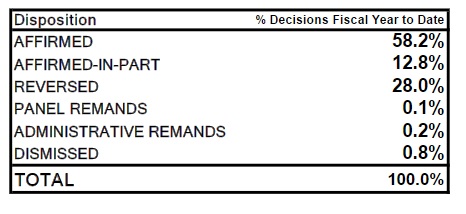
After all the amendments have been made and arguments presented, an applicant is left with no choice but to appeal,  The cost of an appeal is not insignificant, with a Notice of Appeal Fee, the cost of preparing the Brief on Appeal, and the Appeal consideration fee, an applicant can easily spent $8,000 to $12,000, before oral argument.  The time involved is also considerable — typically three to four years. The current (2016) success rate is about 40%, with Examiner being affirmed about 58.2% of the time, being reversed about 28.0% of the time, and partially reversed another 12.8% of the time.
ExParteAppeals2016

i

And in the Alternative . . .

The older among us have “unlearned” the prohibition of the word “or” in patent claims, and have reasoned that if “or” is acceptable, its cousin “and/or” is acceptable in patent claims as well.  A few years ago, the USPTO confirmed this in Ex Parte Gross, App. 11/565/441, (PTAB 2014).  Mr. Gross claimed:

forming a website collective whose members include a plurality of different websites characterized by a common parameter including at least one of a common content topic, and/or a common contractual arrangement.

The Examiner took exception to “and/or” rejecting the claim as indefinite.  The Board of Appeals reversed the Examiner, agreeing with Mr. Gross that “‘and/or’ covers embodiments having element A alone, element B alone, or elements A and B taken together.”  The Board did add that the preferred verbiage” would be “at least one of A and B” and not “at least one of A an/or B.”

Thus “and/or” in a claim is not necessarily indefinite, but it is not the preferred way to write a claim.

Not All Processes That Employ Only Independently Known Steps are Unpatentable

In Rapid Litigation Management Ltd. v. Cellzdirect, Inc., [2015-1570] (July 5, 2016), the Federal Circuit vacated summary judgment that U.S. Patent No. 7,604,929 on hepatocytes capable of surviving multiple freeze-thaw cycles was invalid under §101 as directed to a patent ineligible law of nature.

The Federal Circuit analyzed the claims, directed to a method of produce a desired preparation of multi-cryopreserved hepatocytes” finding that the claims are “simply not directed to the ability of hepatocytes to survive multiple freeze-thaw cycles” as the district court erroneously found.  instead, the Federal Circuit said, the claims are directed to a new and useful laboratory technique for preserving hepatocytes.  The Court said:

This type of constructive process, carried out by an artisan to achieve “a new and useful end.” is precisely the type of claim that is eligible for patenting.

The Federal Circuit observed that the inventors discovered the cells’ ability to survive multiple freeze-thaw cycles, but that is not where they stopped nor was that what they patented.  As the first party with the knowledge of the cells ability, they were in an excellent position to claim applications of that knowledge.

Although the Federal Circuit found the subject matter patentable at Step 1 of the Alice/Mayo two part test, the Federal Circuit said that it would have passed Step 2 of the test even though each of the individual steps was well known. The Federal Circuit said that not all processes that employ only independently known steps are unpatentable.  To the contrary, the claims must be viewed as a whole, considering their elements both individually, and as an ordered combination.

In the present case the steps of freezing and thawing were well known, but a process of preserving cells by repeating those steps was itself far routine and conventional. Repeating a step that the art taught should be performed only once “can hardly be considered routine or conventional.”  To require something more at step two ” would be to discount the human ingenuity that comes from applying a natural discovery in a way that  achieves a new and useful end.

Posted in 101

Plausibility vs. Enablement

U.S. Patent No. 8,330,305 covers protecting devices from impact damage. The patent claims detecting that the portable device will impact a surface, and, if the risk of damage to the portable device from the impact exceeds a damage threshold; altering the orientation of the portable device so that the air bag will impact the surface first, and deploying the airbag before the device impacts the surface.

8330305


The embodiment shown appears to be a cell phone, and it is hard to imagine that a reasonably sized cell phone could contain both an airbag and a system that could reorient the cell phone in a ~42 inch drop from the hands of a user.  In 7200 words and a dozen figures, the disclosure seems to barely meet the plausibility threshold, let alone enablement required under 35 USC 112(a).


Inventive Concept Can be Found in Non-conventional and Non-generic Arrangement of Known, Conventional Pieces

In Bascom Global Internet Services, Inc., v. AT&T Mobility LLC, [2015-1763] (June 27, 2016), the Federal Circuit reversed the dismissal of of the Complaint for failure to state a claim upon which relief can be granted on the grounds that the claims of U.S. Patent No. 5,987,606 are invalid as a matter of law under 35 U.S.C. § 101.

AT&T argued that the claims were directed to the abstract idea of “filtering Internet content,” which is a well-known “method of organizing human activity” like the intermediated settlement concept that was held to be an abstract idea in Alice.  BASCOM responded by arguing that the claims are not directed to an abstract idea because they address a problem arising in the realm of computer networks, and provide a solution entirely rooted in computer technology, similar to the claims at issue in DDR
Holdings.

The Federal Circuit agreed with the district court that filtering content is an abstract idea because it is a longstanding, well-known method of organizing human behavior, similar to concepts previously found to be abstract.  The Federal Circuit said that the claims and their specific limitations do not readily lend themselves to a finding that they
are directed to a nonabstract idea, so it defered consideration of the specific claim limitations’ narrowing effect for step two of the Alice analysis.

The Federal Circuit agreed with the district court that the limitations of the claims, taken individually, recite generic computer, but disagreed with the district court’s analysis
of the ordered combination of limitations.  The Federal Circuit said that The inventive concept inquiry requires more than recognizing that each claim element, by itself, was
known in the art. The Federal Circuit said that an inventive concept can be found in the non-conventional and non-generic arrangement of known, conventional pieces.

The Federal Circuit said that on this limited record before it, the specific method of filtering Internet content cannot be said, as a matter of law, to have been conventional or generic.  The Federal Circuit found that the claims do not merely recite the abstract idea of filtering content along with the requirement to perform it on the Internet, or to perform it on a set of generic computer components.

The Federal Circuit concluded that the claims were directed to the abstract idea of filtering content, but that BASCOM had  adequately alleged that the claims pass step two of Alice’s two-part framework.


Posted in 101

A Combination of References Can be Obvious Even it Requires a Bit of Work

In Allied Erecting v. Genesis Attachments, LLC, [2015-1533](June 15, 2016), the Federal Circuit affirmed the PTAB’s decision in IPR2014-001006 that claims 1–21 of U.S. Patent No. 7,121,489, were obvious.

Allied first challenged the motivation to combine the references,  arguing that the proposed combination would would entail design and structural changes. However, the Federal Circuit said that it is not necessary that the reference be physically combinable to render the claimed invention obvious.  The criterion is not whether the
references could be physically combined but whether the claimed inventions are rendered obvious by the teachings of the prior art as a whole.  The Federal Circuit added that the fact that a modification has simultaneous advantages and disadvantages does not necessarily obviate motivation to combine.

Allied also argued that the references teach away from the combination.  The Federal Circuit disagreed that the reference taught away from the combination, saying that teaching away is when a person of ordinary skill would be discouraged from following the path set out in the reference, or would be led in a direction divergent from the path that was taken by the patentee.  The Federal Circuit noted that the reference did not teach away from the combination because the reference did not address the structure of the second reference.


Board Not Limited to Prior Art in the Grounds, as Long as Patent Owner Had Notice

In Genzyme Therapeutic Products Limited v. Biomarin Pharmaceutical, Inc., [2015-1720, 2015-1721](June 14, 2016), the Federal Circuit affirmed the PTAB’s decisions in IPR2013-00534 and IPR2013-00537 that certain claims of  U.S. Patent No. 7,351,410 and U.S. Patent No. 7,655,226 were invalid for obviousness.

Genzyme’s APA challenged the result under the Administrative Procedures Act because the Board cited references in its final written decisions that were not specifically included in the combinations of prior art on which the Board instituted review.  The Federal Circuit was unmoved, explaining that the introduction of new evidence in the course of the trial is to be expected in inter partes review trial proceedings and, as long as the opposing party is given notice of the evidence and an opportunity to respond to it, the introduction of such evidence is perfectly permissible under the APA.

The Federal Circuit said that Genzyme’s argument reflected a misunderstanding
of the role of the institution decision in inter partes review proceedings before the Board. There is no requirement, either in the Board’s regulations, in the APA, or as a matter of due process, for the institution decision to anticipate and set forth every legal or factual
issue that might arise in the course of the trial.  The critical question for compliance with the APA and due process is whether Genzyme received “adequate notice of the issues that would be considered, and ultimately resolved, at that hearing.” Ultimately the Federal Circuit blamed Genzyme for not either moving to exclude the added references or seeking leave to file a surreply.

The Federal Circuit held in Ariosa that the Board may consider a prior art reference to show the state of the art at the time of the invention, regardless of whether that reference was cited in the Board’s institution decision, and that is how the Board used the contested references.


Halo Recognizes that Not All Infringers are Angels

In Halo Electronics, Inc. v. Pulse Electronics, Inc., 579 U.S. — (2016), the Supreme Court rejected the Federal Circuit’s two-step Seagate test for the award of enhanced damages under 35 USC 284, holding that the aware of enhanced damages was within the discretion of the trial court, subject to review for abuse of that discretion.

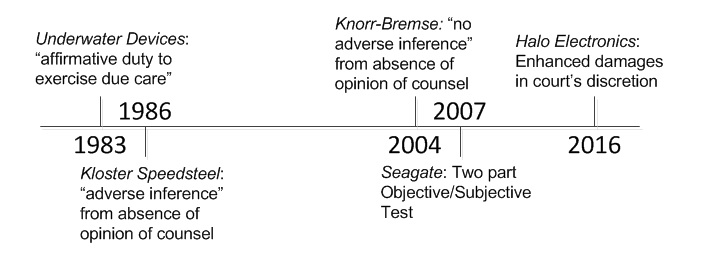
The award of enhanced damages under Section 284 has had ups and downs under the Federal Circuit’s supervision.  Shortly after the Federal Circuit was created, in Underwater Devices, the Federal Circuit announced an “affirmative duty to exercise due care.”  Three years later in Kloster Speedsteel,  the Federal Circuit created an adverse inference from not introducing an opinion of counsel to demonstrate a lack of willfulness.  This adverse inference persisted until 2004, when the Federal Circuit recognized the gamesmanship surrounding opinions of counsel, and eliminated the adverse inference in Knorr-Bremse.  Then in 2007 the Federal Circuit raised the bar higher in Seagate establishing a two part, objective/subjective test.

Halo

Under Seagate, a patent owner must first show by clear and convincing evidence that the infringer acted despite an objectively high likelihood that its actions constituted infringement of a valid patent. Second, the patentee must demonstrate, again by clear and convincing evidence, that the risk of infringement was either known or so obvious that it should have been known to the accused infringer.  The Supreme Court said that this test is not consistent with 35 USC 284.

§284 provides simply that “the court may increase the damages up to three times the amount found or assessed.”  The Supreme Court noted that the statute contains no explicit limit or condition, and that the word “may” clearly connotes discretion.  However discretion is not without limits: a motion to a court’s discretion is a motion, not to its inclination, but to its judgment; and its judgment is to be guided by sound legal principles.

The Supreme Court instructed that awards of enhanced damages under the Patent Act over the past 180 years establish that they are not to be meted out in a typical infringement case, but are instead designed as a “punitive” or “vindictive” sanction for egregious infringement behavior. The Court said that:

The sort of conduct warranting enhanced damages has been variously described in our cases as willful, wanton, malicious, bad-faith, deliberate, consciously wrongful, flagrant, or—indeed—characteristic of a pirate.

Seagate reflects a sound recognition that enhanced damages are generally appropriate under §284 only in egregious cases, but the Supreme Court found the test “unduly rigid, and it impermissibly encumbers the statutory grant of discretion to district courts.”  In particular, the court was critical of the requirement of a showing of objective recklessness, finding no reason for the requirement in the context of deliberate wrongdoing.  The Federal Circuit said that the requirement of objective recklessness insulates an infringer from enhanced damages, so long has he or she can mount a reasonable defense, even if he did not act on the basis of a  defense or was even aware of it. The Supreme Court complaint that:

Under that standard, someone who plunders a patent—in- fringing it without any reason to suppose his conduct is arguably defensible—can nevertheless escape any come- uppance under §284 solely on the strength of his attorney’s ingenuity.

The Supreme Court said that culpability is generally measured against the knowledge of the actor at the time of the challenged conduct.  The Court found no reason to look to facts that the defendant neither knew nor had reason to know at the time he acted.  The Court said that Section 284 allows district courts to punish the full range of culpable behavior, although nothing says they must do so. As with any exercise of discretion, courts should continue to take into account the particular circumstances of each case in deciding whether to award damages, and in what amount. Consistent with nearly two centuries of enhanced damages under patent law, however, such punishment should generally be reserved for egregious cases typified by willful misconduct.


The Board Cannot Adopt a Surprise Claim Construction

In SAS Institute, Inc. v. Complementsoft,LLC, [2015-1346, 2015-1347] (June 10, 2016), the Federal Circuit agree with the Board in an IPR involving U.S. Patent No. 7,110,936 on all of the challenged constructions resulting in finding of invalidity of all but one of the challenged claims.  The Federal Circuit also confirmed that the Board did not need to address in its final written decision claims for which IPR was not instituted.  Finally, the Federal Circuit vacated the Board’s determination that claim 4 is patentable and remanded so that the parties may address a new construction that the Board adopted in its final written decision after interpreting the claim differently before.

With respect to claim 4, which was sustained based upon a different construction of the phrase “graphical representations of data flows, the Federal Circuit remanded so that the parties could address the construction in the final written decision.  The Federal Circuit agreed with the construction of graphical representations of data flows” as “a graphical representation comprised of icons depicting data processing steps and arrows to depict the movement of data through source code.”  The Federal Circuit noted that the term was not used in the specification, and agreed with the Board’s use of the definition of the term “data flow diagrams,” which did appear in the specification.

The Federal Circuit rejected petitioner’s argument that because the construction was narrow, it could not be the broadest reasonable interpretation, saying:

While we have endorsed the Board’s use of the broadest reasonable interpretation standard in IPR proceedings, we also take care to not read “reasonable” out of the standard. This is to say that “[e]ven under the broadest reasonable interpretation, the Board’s construction cannot be divorced from the specification and the record evidence, and must be consistent with the one that those skilled in the art would reach.”

The Federal Circuit also relied upon the structure of the claims, noting that some of the claims speak broadly of flows, while others speak of data flows and program flows, was instructive as to the meaning of the claims (although this is not claim differentiation).

The Federal Circuit affirmed the Board’s invalidation of claims in the face of patent owner’s arguments that the claim constructions were incorrect.  The Federal Circuit specifically noting that because the specification and prosecution history did not conclusively resolve construction, it was appropriate for the Board to rely on dictionaries and expert testimony to aid its construction.

The most interesting aspect of the case may be the Federal Circuit’s treatment of the Board’s change in claim construction between the Institution Decision and the Final Written Decision, which gave the Federal Circuit “pause.”  The Federal Circuit noted that the Board’s new construction of “graphical representations of data flows” as “a graphical representation comprised of icons depicting data processing steps and arrows to depict the movement of data through source code,” varied varied significantly from its initial interpretation of the term as “a map of the path of data through the executing
source code.”  The Federal Circuit was not concered that the Board changed its construction, which the Federal Circuit said it was free to do, but that it Petitioner was not given an opportunity to address the new construction since the Patent Owner agreed with the original construction, and never suggested that the Board adopt the
construction that eventually materialized in the final written decision. Under these circumstances, the Federal Circuit said that it was difficult to imagine either party anticipating that already-interpreted terms were actually moving targets, and it is thus unreasonable to expect that they would have briefed or argued hypothetical constructions not asserted by their opponent.  The Federal Circuit vacated the decision, and remanded for further proceedings.