About: about

About is one of the great weasel words of patent claim drafting.  Few things look as dangerous to a patent drafter as the sharp edge of a numerical limitation without the blunting influence of “about.”  “About” has been used in the claims of about 22% of utility patents issuing since 1976.  While it is frequently employed by drafters, often not much care is taken in properly defining its boundaries.  In Ferring B.V. v. Watson Laboratories, Inc. – Florida, [2014-1377] (Fed. Cir. 2014), the determination of infringement turned on the meaning of “about” in the phrase “less than about 70%”.  Ferring argued that about meant +/- 10%, based upon some language in a test referenced in the claim language, so that less than about 70% actually meant less than 63% to 77%.  Apotex meanwhile argued that it meant +/- 5%, so that about 70% actually meant less than 66.5 to 73.5%, which did not encompass the less than 75% of Apotex’s product.  In the absence of any defintion in the patent, the Federal Circuit declined to place a numerical limitation on “about,” instead giving about its ordianry meaning:

“About” is not defined either explicitly or by implication by the specification. We think that the district court did not err in giving the term “about” its ordinary meaning and in refusing to give it a more specific construction. See also Merck & Co., Inc. v. Teva Pharms. USA, Inc., 395 F.3d 1364, 1369–70 (Fed. Cir. 2005) (the term “about” should be given its ordinary and accepted meaning of “approximately” unless the patentee clearly redefines “about” in the specification). We affirm the district court’s construction of “about” to mean “approximately,” as well as its refusal to construe “about” to represent a particular numerical error rate.

“About” is a often used and time honored weasel word, but to be used to best effect, some standard should be provided for determining its effect on the so-modified claim element.
construction

Clear and Unmistakable Disavowal Incorporated by Reference

In X2Y Attenuators, LLC v. ITC,  2013-1340 (Fed. Cir. 2014), the Federal Circuit affirmed the ITC’s construction of U.S. Patent Nos. 7,609,500, 7,916,444, and 8,023,241. Intel argued that the claims should be limited to a sandwich configuration, while X2Y contended that the electrode terms require no construction and should be given their plain and ordinary meanings, and the ITX agreed with Intel.  The Federal Circuit agreed that the “exacting” standard of disavowall was:

The patents’ statements that the presence of a common conductive pathway electrode positioned between paired electromagnetically opposite conductors is “universal to all the embodiments” and is “an essential element among all embodiments or connotations of the invention” constitute clear and unmistakable disavowal of claim scope.

Labeling an element of embodiment “essential” has been found to be a disavowal, and further labelling it “universal to all embodiments” reinforced the conclusion.

One of the patents contained the “essential” disavowal, and the other patents incorporated the “essential” disavowal by reference.  All of the patents incorporated the “universal” disavowal.  The Federal Circuit said that the incorporated patents are “effectively part of the host patents as if they were explicitly contained therein.”  The Federal Circuit conceded that it was possible that a clear and unmistakable disavowal in an incorporated patent is no longer so when placed in the context of the disclosure of the host patent, but that was not the case with the patents in suit.

The lesson of this case is to be careful what its described as “essential” or “universal,” both in the current specification, and in anything incorporated by reference


Supreme Court: Claims Must Inform, with Reasonable Certainty

Nautlius, Inc. v. Biosig Instruments, Inc., — U.S. —, (2014), the Supreme Court rejected the Federal Circuit’s “insolubly ambiguous” test for indefiniteness under 35 U.S.C. §112, holding that “a patent is invalid for indefiniteness if its claims, read in light of the specification delineating the patent, and the prosecution history, fail to inform, with reasonable certainty, those skilled in the art about the scope of the invention.” The case arrived at the Supreme Court after the Federal Circuit reversed a district court finding that the claims of U.S. Patent No. 5,337,753 on a heart rate monitor, which claimed electrodes contained the language “spaced relationship” were indefinite. The Supreme Court “cognizant of the competing concerns” read Section 112 to require that a patent’s claims , viewed in light of the prosecution history, inform those skilled in the art about the scope of the invention with reasonable certainty.” The Supreme Court explained that this standard “mandates clarity, while recognizing that absolute precision is unattainable” and accords with the Court’s decisions that the certainty that the law requires of patents “is not greater than is reasonable, having regard to their subject-matter.” The Court declined to apply the standard to the claims, remanding the case for further consideration.

Interviewing Examiners – The Personal Touch to Prosecution

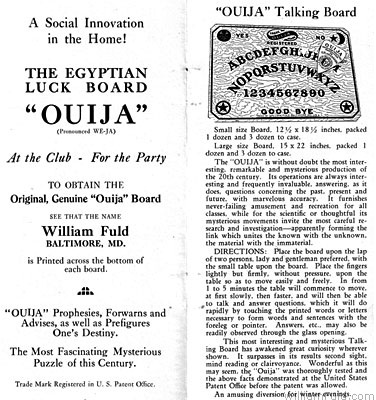
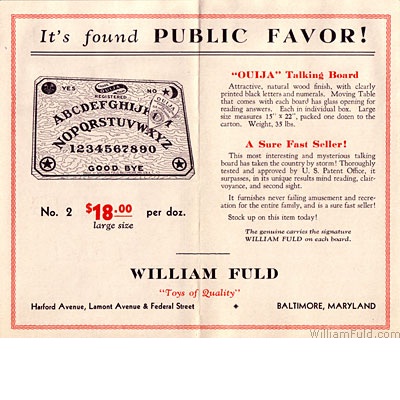
February 10, 2014, marked the 123rd anniversay of the issuance of U.S. Patent No. 446,054 on the Ouija Board.  As the story is told by descendants of the inventors, the Patent Examiner refused to issue a patent without proof tha the invention worked.

The requested demonstration was made during an Examiner Interview, as dramatically recounted in the Smithsonian in October 2013:

the chief patent officer demanded a demonstration—if the board could accurately  spell out his name, which was supposed to be unknown to Bond and Peters, he’d  allow the patent application to proceed. They all sat down, communed with the  spirits, and the planchette faithfully spelled out the patent officer’s name.  Whether or not it was mystical spirits or the fact that Bond, as a patent  attorney, may have just known the man’s name, well, that’s unclear, Murch says.  But on February 10, 1891, a white-faced and visibly shaken patent officer  awarded Bond a npatent for his new “toy or game.”

Read more:  http://www.smithsonianmag.com/history/the-strange-and-mysterious-history-of-the-ouija-board-5860627/#ixzz2t35YW21m.  What actually happened during the interview is a mystery — a problems with many Examiner Interviews today, despite the provisions of 37 CFR 1.133 and MPEP 716.  We do know that the patent did issue, and that the patent owners used the issuance as an endorsement of the operability of their invention for many years.

It’s What You Claim, Not What You Meant to Claim, That Counts

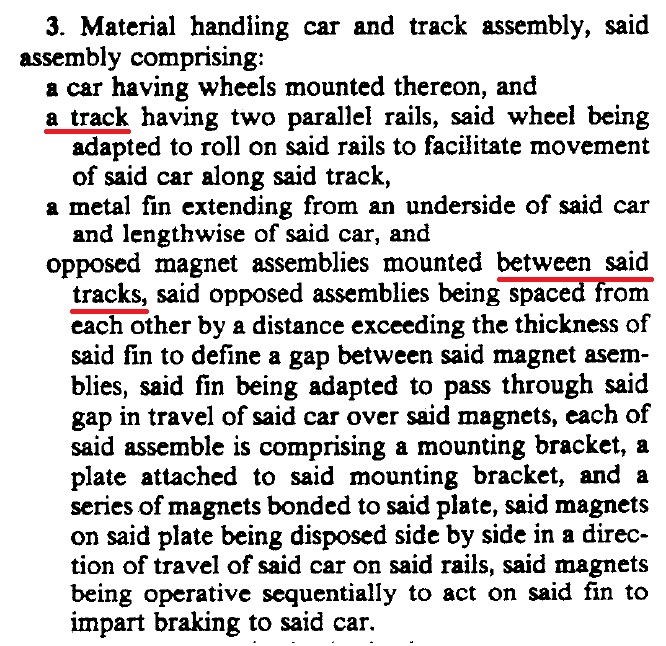
On February 7, 2014, Magistrate Thynge issued a report and recommendation in  Magnetar Technologies Corp. v Six Flags Theme Parks, Inc., 07-127-LPS-MPT (D.Del) that among other things found Claim 3 of U.S. Patent No. 5,277,125 invalid for indefiniteness.  Claim 3 states:

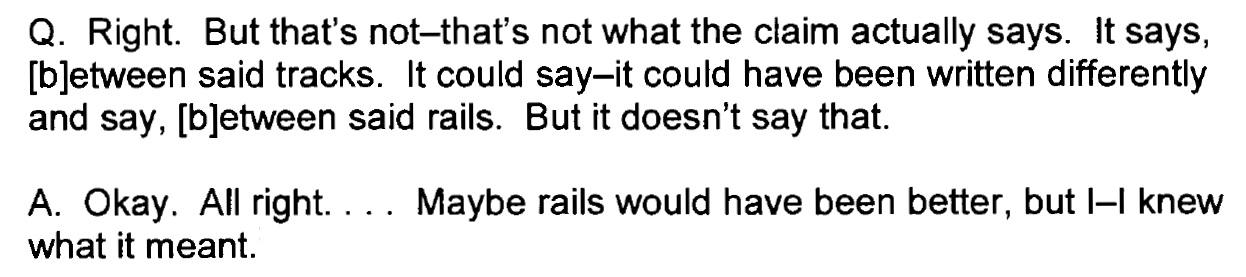
The problem is that Claim 3 specifies a track, but then calls for magnet assemblies between said tracks.  The inventor testitifed that he knew what it meant:

But it did not say what he meant.  This is reminsecent of Chef America v. Lamb Weston, 358 F.3d 1371 (Fed. Cir. 2004) where the claim “heating to” rather than “heating at” 450° proved fatal to the patent.

There were serveral possible fixes, none of which were made.  Precisely because there were serveral fixes, Magistrate Thynge found that correction would be subject to reasonable debate, so that Court was unable to correct the error under Novo Indus., L.P. v. Micro Molds Corp., 350 F.3d 1348, 1354 (Fed. Cir. 2003).  The Magistrate granted summary judgment that claim 3 of the ‘125 patent is invalid for indefiniteness under 35 U.S.C. § 112, Paragraph ¶2.

Even of the District Court does not adopt this part of the Magistrate’s recommendation, at a minimum the less than precise language of claim 3 wasted time and resources of the patentee.  Words of a patent claim are critical, and everyone connected with the patent is responsible for making sure it is correct.


Can a Plurality of Patent Lawyers Writing A Plurality of Patents be Wrong?

Perhaps patent lawyers most favorite word is “plurality.” It is a convenient way to say “two or more” in a patent.  Its long standing use (the word plurality appears in 2,503,611 patents since 1976 — just under 50% of patents issuing) and well established construction by the Federal Circuit (see, e.g., Dayco Products, Inc. v. Total Containment, Inc., 258 F.3d 1317 (Fed. Cir. 2001) make it a reasonable choice in a patent application.

While “plurality” may not be as lay person friendly as “two or more,” it is not obscure, and is easily explained in a claim construction.  Moreover “two or more” might not be given the same range of equivalents as “plurality.”  Thus, the plurality of patent attorneys who use the word, probably have it right, although it would be hard to fault a prosecutor who preferred to use “two or more.”


A Special Brand of Claim Drafting

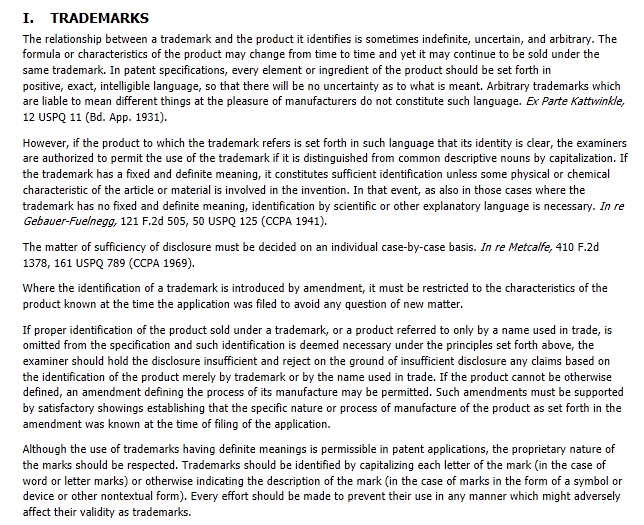
Sometimes an invention employs a proprietary branded product and the only way to describe and claim it is to refer to it by the trademark.  This presents unique problems for the patent prosecutor because a branded product is usually not in the control of the patent applicant, and thus can change after the application is drafted and filed.  This is a particular problem in the claims, where the changing scope could invalidate the claim or make the claim impossible to infringe.  The MPEP addresses the use of trademarks in a patent application:


VELCRO appears the claims of 2077 patents, TEFLON appears om the claims of 3585 patents, ETHERNET appears in the claims of 7425 patents, and JAVA appears in 3690 patents.  For examples, see U.S. Patent No. 6,959,462, Claim 2 (VELCRO); U.S. Patent No. 8,485,489, Claim 12, and 8,062,571, claim 4 (TEFLON); U.S. Patent No. 8,457,003, Claims 2, 3, U.S. Patent No. 8,422,359, claim 10, and U.S. Patent No. 8,363,655, claim 5 (ETHERNET); and U.S. Patent No. 8,330,862, Claim 4, and U.S. Patent No. 8,254,757 (JAVA).

When Being Critical is Critical

It is well established that a patentee may limit the scope of the claims by disavowal, and one of the many ways such disavowal can occur is by criticizing the prior art.  When a patent specification criticizes the prior art, it is presumed that the invention does not share the criticized featuers.  Thus in Chicago Board Options Exchange, Inc., v. International Securities Exchange, LLC., (Fed. Cir. 2012) the Federal Circuit affirmed the district court’s finding of disavowal noting that “the specification goes well beyond expressing the patentee’s preference for a fully automated exchange over a manual or a partially automated one, and its repeated derogatory statements about the latter reasonably may be viewed as a disavowal of that subject matter from the scope of the Patent’s claims.”  Criticism of the prior art also limited the claims in In re Abbott Diabetes Care, Inc., (Fed. Cir. 2012), but this time to the applicant’s advantage.  Abbott successfully argued that the broadest reasonable interpreation of its claims on appeal was at least in part limited by its criticism of the prior art.

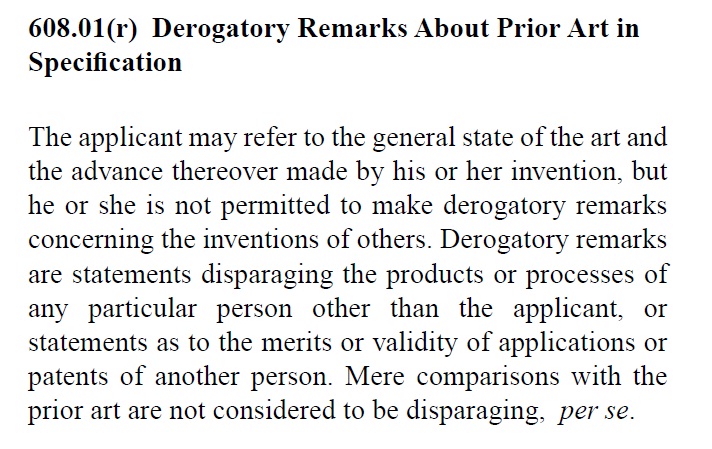
A patent prosecutor should be aware of the limiting effect of criticisms of the prior art.  Sometimes they help the applicant (Abbott), but sometimes they hurt (Chicago Board).  Like most things in the law, an absolute rule against being critical of the prior art is not appropriate, but it must be done carefully and thoughtfully.  Moreover, a good prosecutor will recall that the MPEP prohibits disparagement of the prior art:

Maybe Mom had the best advice for prosecutors. . . “If you can say anything nice, don’t say antyhing at all.”

Copyright in Patent Text and Drawings

There has been alot of comment recently about the fact that Fig. 5 from Google’s U.S. Patent Application 2013/0181936:

Fig. 5, US Patent Application No. 2013/0181936

looks alot like Fig. 12 from Apple’s U.S. Patent No. 8,089,233:

Fig. 12, US Patent No. 8,098,233

If one of these figures was copied from other, would this be copyright infringement?

37 CFR 1.71(d) alows a copyright or mask work notice to be placed in a design or utlity patent adjacent the material for which copyright or mark work protection is claimed.  Inclusion of copryight notice is only permitted if the authoriziation of 37 CFR 1.171(e) is also included:

A portion of the disclosure of this patent document contains material which is subject to (copyright or mask work) protection. The (copyright or mask work) owner has no objection to the facsimile reproduction by anyone of the patent document or the patent disclosure, as it appears in the Patent and Trademark Office patent file or records, but otherwise reserves all (copyright or mask work) rights whatsoever.

37 CFR 1.84(c) permits copyright notice on patent drawings under the condidtions.

M.P.E.P. 608.01(v)(II) staes that:

The inclusion of a copyright or mask work notice in a design or utility patent application, and thereby any patent issuing therefrom, under the conditions set forth above will serve to protect the rights of the author/inventor, as well as the public, and will serve to promote the mission and goals of the U.S. Patent and Trademark Office. Therefore, the inclusion of a copyright or mask work notice which complies with these conditions will be permitted. However, any departure from these conditions may result in a refusal to permit the desired inclusion. If the authorization required under condition (C) above does not include the specific language “(t)he (copyright or mask work) owner has no objection to the facsimile reproduction by anyone of the patent document or the patent disclosure, as it appears in the Patent and Trademark Office patent files or records,…” the notice will be objected to as improper by the examiner of the application.

However, does the absence of copyright notice and authorization of 37 CFR 1.71(d),(e) dedicate the copyrighted material to the public?  Copyright notice is not usually a prerequisite to copyright protection.  The Berne Convention prohibits the imposition of formalities such as notice or registration as a prequisite to copyright protection.  It would not seem that the U.S.P.T.O. could impose by implication from its regulations, a requirement of copyright notice as a prerequisite to copyright protection.

Whether or not copyright notice is a prerequisite to protection, it seems like a good idea, and U.S. Patent No. D687,048, which issued on July 30, 2013, illustrated how it can be done.

US Patent No. D687048