October 24, 2024

On October 24, 1876, U.S. Patent No. 183725 issued to Seth E. Thomas (son and namesake of the founder of Seth Thomas & Sons clock making enterprise) on an Improvement in Clock-Cases.
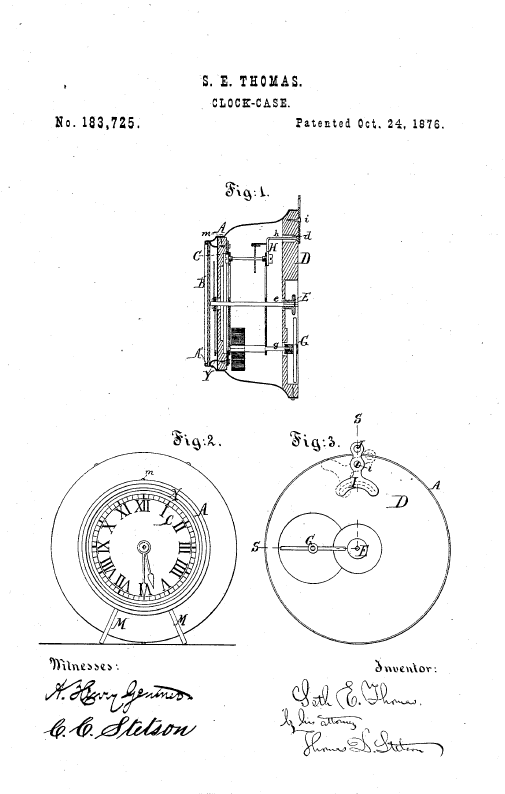
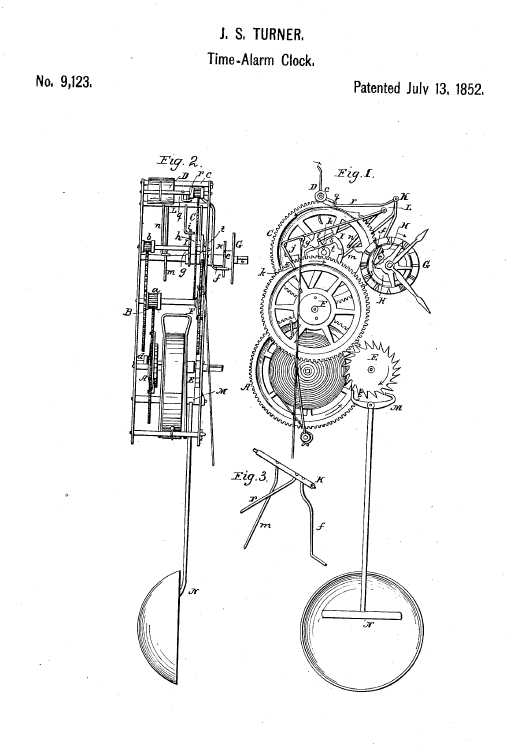
The case was particularly adapted for the now familiar back-winding alarm clock. There were alarm clocks before this (and the patent indicates that “[t]he works need involve no novelty”). Levi Hutchins is credited with one of the first U.S. alarm clocks in 1787. The alarm on this clock had a preset time that could not be changed. U.S. Patent No. X7154 from 1832 on an Alarm Bell, For Time Pieces, Alarm Clock discloses a bell for an alarm clock. U.S. Patent No. 1956 from 1841 mentions the “common alarm clock.” U.S. Patent No. 9123 from 1852 is the first U.S. on an alarm clock per se.
October 23, 2024

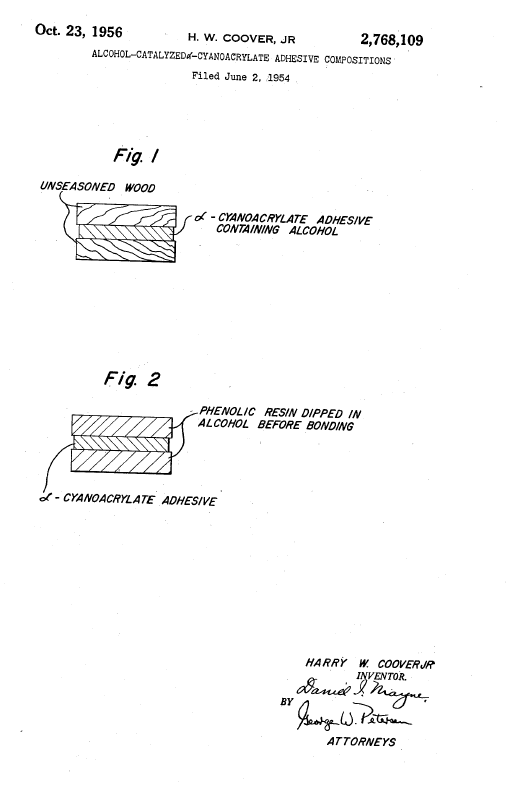
On October 23, 1956, Harry W. Coover, Jr., was awarded U.S. Patent No. 2,768,109, on Alcohol-Catalyzed alpha-Cyanoacrylate Adhesive Compositions:

This patent was assigned to Eastman Kodak Company, which began selling Coover’s adhesive under the brand SUPER GLUE in 1958.

Coover received his B.S. from Hobart College and his M.S. and Ph.D. from Cornell University. Coover, and received more than 460 patents.

October 14, 2024

Before modern sensibilities, Christopher Columbus’ achievement in sailing across the Atlantic Ocean in 1492 was celebrated, including in the U.S. Patent Collection. U.S. Patent No. 21448 was issued on a design for a Buckle (with the image of Christopher Columbus):

U.S. Patent No. D21573 issued on a Badge featuring the image of Christopher Columbus:

U.S. Patent No. D221,221 issued on a Spoon featuring Columbus’ ship:

U.S. Patent No. D21255 on the design of a Medal featuring the image of Christopher Columbus:

U.S. Patent No. 418455 issued on an Educational Globe that tracks that voyage of Columbus.

October 9, 2024

On October 9, 1855, Isaac M. Singer received U.S. Patent No. 13661 on a Sewing Machine:

Of course, Singers’ was not the first patent on a sewing machine. Elias Howe is generally regarded as the first inventor of the sewing machine, and he received U.S. Patent No. 4750 on September 10, 1846:

Howe also received U.S. Patent Nos. 16,436 on January 20, 1857, 17679 on June 30, 1857, and 21158 on August 24, 1858. However, rather than making and selling machines himself, Howe made his fortune by suing those who he felt had infringed on his patents.

October 8, 2024

On October 8, 1940, David C. Rockola received U.S. Patent No. D122,946 on a Cabinet for Remote Control Apparatus:

This was not the first patent by this prolific inventor, that was U.S. Patent No. USD81021 that issued more than ten years earlier in 1930, and it was far from the last, that was U.S. Patent No. US 3771691 that issued more than thirty years later in 1973.

David Rockola invented everything from gaming devices, to parking meters, to vehicles, to juke boxes — what his is probably best know for.

It turns out that ROCKOLA was not just a snappy name for juke boxes, but it a snappy name for a prolific inventor who did far more than juke boxes.

October 7, 2024

On October 7, 1975, Ysidore M. Martinez received U.S. Patent No, 3,909,854 on a Knee Implant Prosthesis:

Ysidore, an amputee, revolutionized the prosthetic field by creating a prosthesis that was better at giving the wearer control of acceleration and deceleration, while simultaneously reducing pressure and friction for the wearer. This concept, a departure from trying to make prosthetics that faithfully mimicked the limb being replaced, is still used in prosthesis’ today.

October 6, 2024

On October 6, 2024, Chester F. Carlson a physicist, patent attorney, and inventor, received U.S. Patent No. 2,297,691 on Electrophotography – photocopying:

Chester did is initial work in a laboratory in Astoria, Queens, New York. The very first photocopied image was made there on October 22, 1928, which consisted of the date and place written by his laboratory assistant Otto Kornei, an out-of-work Austrian physicist.

The initial results thrilled Carlson, but Kornei was so discouraged, that within a year he left Carlson on cordial terms, dissolving his agreement with Carlson that would have given Kornei ten percent of Carlson’s future proceeds from the invention and rights in the inventions they had worked on together. Oops!

Carlson persisted, and eventually his ideas became the backbone of the Xerox Corporation. Xerox was a combination of the Greek words xeros (“dry”) and graphein (“writing”).  

October 5, 2024

On October 5, 1869, Fisher Spofford and Matthew Raffington received U.S. Patent 95,531 on Improvement in Water-Velocipedes:

Apparently, bicycling on water preoccupied the 19th century mind, because there are numerous

The fascination with bicycling on water even carried into the 20th Century:

October 4, 2024

On October 4, 1949, Harry Crooks, Mildred Rebstock, John Controulis, and Quentin Bartz received U.S. Patent No. 2,483,885 on Nitrophenyl Acyl Amido Alkane Diols:

Dr. Mildred “Millie” Rebstock was a researcher working for Parke, Davis & Company when she was charged with synthesizing a new antibiotic discovered in a culture of Streptomyces venezuela. Dr. Rebstock and her team found a way to fully synthesize this antibiotic, which allowed it to be economically manufactured, rather than producing it organically through fermentation.  This was the first time that an antibiotic has been synthesized. The ready availability of chloromycetin as a result of Rebstock’s Team’s work allowed its use to treat Rocky Mountain Spotted Fever and Typhoid. It is still used today as a secondary treatment for extreme cases of meningitis, cholera, and other bacterial diseases. After chloromycetin was linked to an increased risk of aplastic anemia, its use dropped off in developed nations, but it is still so widely used in developing nations that the World Health Organization has it on its list of Essential Medicines.

October 3, 2024

On October 3, 1950, U.S. Patent No. 2,524,035 issued to J. Bardeen and W.H. Brattain on a Three Electrode Circuit Element Utilizing Semiconductive Material –the transistor:


Their invention ushered in the electronics age starting with simple transistor radios but leading to the microchip and modern computer technology.

The transistor was the work of not just Bardeen and Brattain, but also Willam Shockley (who was left off of the patent for strategic reasons). The trio received the 1956 Nobel prize for physics for their work in transistors. Shockley described the workings of the team as a “mixture of cooperation and competition.” Shockley eventually alienated Bardeen and Brattain, blocking the two from further work on transistors. Bardeen began working on superconductivity for which he won a second Nobel prize. Brattain refused to work with Shockley further and was pursued other interests, before leaving for academia. Shockley continued to improve transistors, developing a more robust layered structure that evolved into the modern bipolar junction transistor.