PTAB Incorrectly Determined that Claimed Element was Printed Matter where that Matter was not Claimed for its Communicative Content

In In re Distefano, [2015-1453] (Fed. Cir. 2015), the Federal Circuit reversed the PTAB’s affirmance of the rejection of claim 24 of Distefano’s patent application, rejecting the PTAB’s determination that “one of the limitations of independent claim 24 fell within the printed matter doctrine and therefore was not entitled to patentable weight.”

Distefano claimed a method of designing web pages.  Claim 24 required:

     24. A method of designing, by a user in a user interface having first and second display regions each capable of displaying a plurality of element [sic], an electronic document, comprising:

selecting a first element from a database including web assets authored by third party authors and web assets provided to the user interface or outside the user interface by the user;

displaying the first element in the second display region;

interactively displaying the electronic document in the first display region;

modifying the first element displayed in the second display region upon receiving a first command to modify the first element in the second display region; and

displaying the modified first element in the first display region, wherein the modified first element forms at least part of the electronic document.

The parties agreed that the  elements other than the highlighted selecting limitation were anticipated, and the PTAB refused to give the selecting limitation patentable weight under the printed matter doctrine. The Federal Circuit explained that it has consistently limited the printed matter rule to matter claimed for its communicative content.  The Federal Circuit explained that only if the limitation in question is determined to be printed matter does one turn to the question of whether the printed matter nevertheless should be given patentable weight. The determination of whether printed matter is given such weight turns on whether the claimed informational content has a functional or structural relation to the substrate.

The Federal Circuit found that the PTAB erred in its application of the first step.  The Federal Circuit recognized that the selected web assets “can and likely do communicate some information” but found that “the content of the information is not claimed.”  Thus, it did not have to decide whether the printed matter should be give printed matter.


HOMAS L. DISTEFANO, III,


A “Connection” Between the Patented Feature and Consumer Demand Is Enough to Support an Injunction

In Apple Inc. v. Samsung Electronics Co., Ltd., [2014-1802] (Fed. Cir. 2015), the Federal Circuit vacated and remanded the denial of Apple’s request for a permanent injunction.

The trial court denied Apple’s proposed injunction despite public interest favoring the injunction, and the narrowness of Apple’s proposed injunction (which tilted the balance of hardships in Apple’s favor), because these factors did not overcome Apple’s lack of irreparable harm.

Apple argued to the district court that it was irreparably harmed by Samsung’s infringement due to damage to its reputation as an innovator, lost market share, and lost downstream sales.  The district court rejected Apple’s arguments regarding irreparable harm, finding that Apple had not shown that a causal nexus connected Samsung’s infringement to these alleged injuries.

The Federal Circuit held that a causal nexus linking the harm and the infringing acts must be established regardless of whether the injunction is sought for an entire product or is narrowly limited to particular features, rejecting Apple’s argument to the contrary.

The Federal Circuit found the district erred, however, with respect to Apple’s allegations of lost market share and lost downstream sales.  The Federal Circuit said that the patent owner proving a causal nexus requires the patentee to show “some connection” between the patented features and the demand for the infringing products.  The Federal Circuit said that it was legal error for the district court to effectively require Apple to prove that the infringement was the sole cause of the lost downstream sales.  Instead, the Court should have determined whether the features “impact” customer’s purchasing decision.  The Federal Circuit said that the fact that the infringing features are not the only cause of the lost sales may well lessen the weight of any alleged irreparable harm, it does not eliminate it entirely.  Thus, the district court thus erred when it required Apple to prove that the infringing features were the exclusive or predominant reason why consumers bought Samsung’s products to find irreparable harm.

The Court concluded that on the record, applying the correct legal standard for irreparable harm, Apple has established irreparable harm.


Certificate of Correction to Correct Information Not Available When Patent Issued

Cubist Pharmaceuticals, Inc. v. Hospira, [2015-1197, 2015-1204, 2015-1259] (November 12, 2015), the Federal Circuit approved the use of a Certificate of Correction to correct information not available at the time the application was filed.

At the time the application was filed, and until well after that patent was issued, it was universally believed that the asparagine amino acid in daptomycin was the L-isomer of asparagine, as set forth in the structural diagram in the patent.  Years after the issuance of the patent researchers discovered that daptomycin actually contains the D-isomer of asparagine, not the L-isomer. Cubist sought to correct the error by requesting a certificate of correction from the Patent and Trademark Office (“PTO”) pursuant to 35 U.S.C. § 255, which was granted.

In subsequent infringement litigation with Cubist, Hospira argued that the PTO had erred by issuing the certificate of correction because the change in the structural diagram altered the substance of the claims, broadening their reach.  However, Cubist’s expert testified that the specification made it clear that the claims of the patent were directed to daptomycin, not to the variant containing the L-isomer of asparagine. Because it was plain that the claims were directed to daptomycin, it was appropriate for the PTO to correct the error in the structural diagram.

The Federal Circuit said that once the PTO has issued a certificate of correction, a
court may invalidate the certificate only upon a showing of clear and convincing evidence that it was improperly issued, which Hospira failed to do.  The Federal Circuit said that the problem with Hospira’s argument was that the district court did not view the change in the diagram as changing the scope of the claims at all. Instead, the district court regarded the change as simply conforming the structural diagram to the compound described in the specification and covered by the claims.


Putting Your Fat Thumb on the Scale of Claim Construction

In Williamson v. Citrix Online, LLC, [2013-1130] (Fed. Cir. 2015), the Federal Circuit reduced the “strong” presumption that a limitation expressed in functional language without using the word “means” is not subject to 35 USC §112, ¶6 (35 USC §112(f)).   The Federal Circuit concluded that this heighted  burden was unjustified, uncertain in meaning and application, shifted the balance struck by Congress in passing § 112, ¶6, and “has resulted in a proliferation of functional claiming untethered to § 112, para. 6 and free of the strictures set forth in the statute.”  The Federal Circuit announced that henceforth the test of whether the words of the claim “are understood by persons of ordinary skill in the art to have a sufficiently definite meaning as the name for structure.”

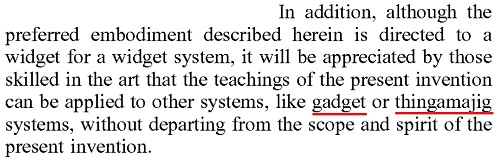
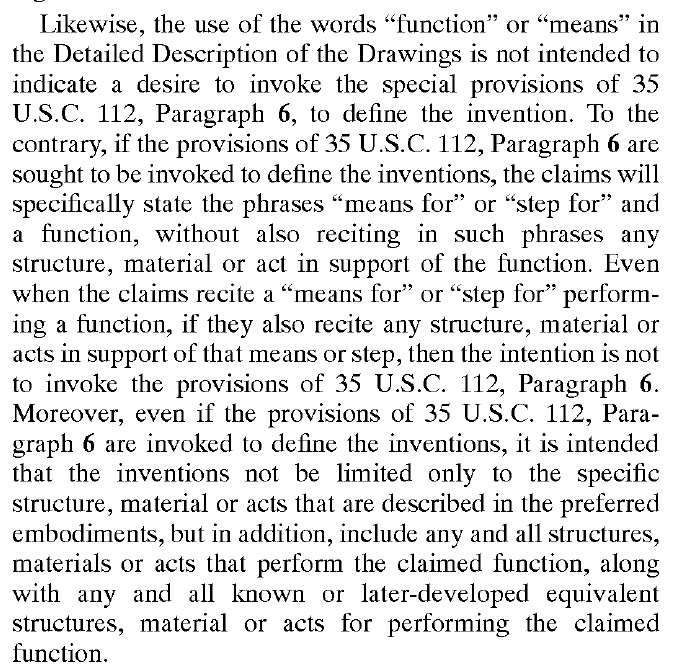
While the Federal Circuit criticized its previous “strong” presumption because of its “inappropriate practical effect of placing a thumb on what should otherwise be a balanced analytical scale” one wonders whether a patent applicant can’t put its thumb back on the scale through definitions.  Consider U.S. Patent No. 6167810, which states:

6167810

The patentee has attempted to recapture the widely misunderstood meaning of “means” prior to In re Donaldson, by covering all possible means for performing the stated function.  Maybe redefining “means” is a step too far, but if the test really is how the words are understood by persons of ordinary skill, would an express statement that “none of the claim terms are intended to be construed under 35 USC §112(f)” affect how a person or ordinary skill in the art would understand the claims?

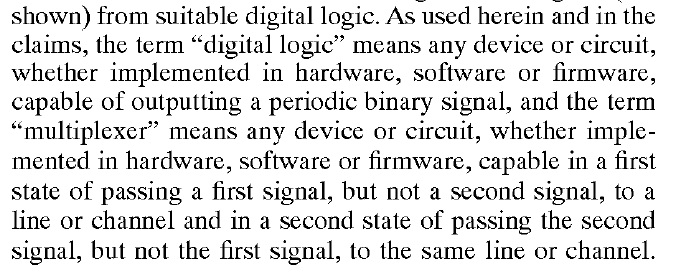
Furthermore, if the test is whether the words of the claim “are understood by persons of ordinary skill in the art to have a sufficiently definite meaning as the name for structure” would a definition help to capture the broadest scope?  Consider this language from U.S. Patent No. 6909672:

6909672

Whether by defining means to include “any means” as in U.S. Patent No. 6167810, or defining a functionally named element  to include “any means” as in U.S. Patent No. 6909672, an applicant can try to exert some control over how the functional elements in its claims will be construed, as long as the applicant is mindful of the written description and enablement requirements of the other parts of §112.

PTO’s refusal to Terminate Inter Partes Reexamination After Litigation Settled Not Reviewable

In Automated Merchandising v. Lee, 2014-1728 (April 10, 2015), the Federal Circuit held that AMS’s challenge to the PTO’s refusal to terminate pending reexaminations cannot proceed because the refusal is not a “final agency action” under the APA, 5 U.S.C. § 704.

AMS sued Crane in for infringement of four patents (U.S. Patent Nos. 6,384,402, 6,794,634, 7,191,915, and 7,343,220). Crane requested inter partes reexamination of the patents.  AMS and Crane settled their suit, with the court issuing a consent judgment that “[t]he parties stipulate that [the four patents] are valid.” AMS then asked the USPTO to terminate the reexamination, but the USPTO refused.  AMS brought an action in district court, challenging the USPTO’s refusal under the APA.  The district court rejected the challenge on the merits, but the Federal Circuit found that the USPTO’s decision was not a final decision that could be challenged under the APA.

Denial of Attorneys Fees Remanded Because Octane lowered “Considerably” the Standards for Fee Awards

In Oplus Technologies, Ltd. v. Vizio, [2014-1297] (April 10, 2015), the Federal Circuit vacated and remanded the district court’s decision not to award attorneys’ and expert witness fees under 35 U.S.C. §285 and 28 U.S.C. §1927.  The Federal noted that since the district court issued its opinion, the Supreme Court’s Octane decision lowered Circuit  “considerably” the standard for awarding fees, and thus the it was appropriate to vacate and remand this case in order for the district court to reconsider the propriety of awarding fees.

The Federal Circuit found that the district court opinion details an egregious pattern of misconduct, and that even Oplus’s counsel agreed that the misconduct was quite severe.   The Federal Circuit said that although an award of fees is within the discretion of the district court, nothing in the opinion or in the record substantiates the court’s decision not to award fees. Given that the district court found counsel’s behavior “inappropriate,” “unprofessional,” “vexatious,” and “harassing,” it is difficult to imagine how defendant had not incurred additional expenses defending against such filings.


No Challenge Possible to PTO’s Revival of Application

In Exela Pharma Sciences, LLC v. Lee, [2013-1206] (March 26, 2015) the Federal Circuit affirmed the dismissal of Exela’s challenge to the revival of SCR Pharmatop patent application that resulted in the issuance of U.S. Patent No. 6,992,218. It was undisputed that SCR Pharmatop failed to properly enter the U.S. National Phase by the 30 month deadline. SCR Pharmatop filed a petition to revive the application, stating that the delay was “unintentional,” using the form provided by the PTO for revival requests. The PTO granted the petition on April 25, 2003, and the application was duly examined, resulting in the ’218 patent. After being sued on the patent, Exela filed a petition in the PTO, under the APA and 37 C.F.R. §§1.181, 1.182, and 1.183, challenging the PTO’s revival of SCR Pharmatop’s application, arguing that “unintentional” delay was not an available ground for revival of a U.S. patent application claiming priority under the PCT-implementing statute as then in effect.  The PTO declined to consider Exela’s petition, stating that no statute or regulation authorizes third party challenge to a PTO ruling concerning revival of a patent application.  Exela brought an action in district court to review this determination, but it was dismissed the action as untimely.  The Federal Circuit affirmed the dismissal, but on the grounds that “PTO revival actions are not subject to third party challenge under the APA.”

This decision in effect completely insulates improper and even illegal action by the USPTO, not only can a third party not challenge the action in the Patent Office, but in view of the Federal Circuit’s decision in Aristocrat Technologies Australia Pty Ltd. v. International Game Technology, 543 F.3d 657 (Fed. Cir. 2008), the party cannot raise it as a defense in an infringement action.

Broadest Reasonable Construction Must Comport with Plain Meaning and Specification

In In re Imes, [2014-1206] (January 29, 2015) the Federal Circuit reversed the rejection of Imes’ claims to a device for communicating digital camera image and video information over a network. Some of the claims required a “wireless communication module.” Purporting to apply the broadest reasonable interpretation, the Examiner rejected these claims in view of prior art that disclosed the use of a memory card to transfer images and videos, pointing out that no wires are used. The Federal Circuit concluded that this construction was “inconsistent with the broadest reasonable interpretation in view of the specification.” The Federal Circuit found the construction “straightforward,” particularly since the term wireless was defined in the specification, and it was used consistently throughout. Also at issue were claims to “wirelessly communicate streaming video” which the Examiner found met by prior art that serially transmits images by email, reasoning that video is just a series of images. The Federal Circuit held “sending a series of emails with attached still images is not the same as streaming video.” Such a construction is unreasonable as it comports with neither the plain meaning of the term nor the specification.”

Complaint for Infringement of A Computer-Related Patent Fails to State a Claim for Relief

Content Extraction and Transmission, LLC v. Wells Fargo Bank, NA, [2013-1588, -1589, 2014-1112, -1687] (Fed. Cir. December 23, 2014) the Federal Circuit affirmed the dismissal under FRCP 12(b)(6) of plaintiff’s action for patent infringement claims, on the grounds that the patent claims did not define patentable subject matter.

The Federal Circuit applied the two-step process established by the Supreme Court in Mayo and Alice. In determining whether the claims were directed to a patent-ineligible abstract idea, the Federal Circuit observed that claims directed to the mere formation and manipulation of economic relations may involve an abstract idea. The Federal Circuit agreed with the district court that the claims are drawn to the abstract idea of 1) collecting data, 2) recognizing certain data within the collected data set, and 3) storing that recognized data in a memory.

The Federal Circuit then moved on to the second step, determining whether the limitations present in the claims represent a patent-eligible application of the abstract idea. The Federal Circuit sad that for the role of a computer in a computer implemented invention to be deemed meaningful, it must involve more than performance of well-understood, routine, and conventional activities previously known to the industry. The Federal Circuit added “the mere recitation of a generic computer cannot transform a patent ineligible abstract idea into a patent-eligible invention.” The Federal Circuit agreed with the district court that the asserted patents contain no limitations — either individually or as an ordered combination — that transform the claims into a patent-eligible application. The Federal Circuit noted that CET conceded at oral argument that the use of a scanner or other digitizing device to extract data from a document was well-known at the time of filing, as was the ability of computers to translate the shapes on a physical page into typeface characters. The Federal Circuit concluded that At most, CET’s claims attempt to limit the abstract idea of recognizing and storing information from hard copy documents using a scanner and a computer to a particular technological environment. Such a limitation has been held insufficient to save a claim in this context.

The Federal Circuit concluded that we conclude that even when construed in a manner most favorable to CET, none of CET’s claims amount to “significantly more” than the abstract idea of extracting and storing data from hard copy documents using generic scanning and processing technology. It therefore found that the district court’s resolution of PNC’s motion to dismiss at the pleading stage was proper.

In another aspect of the case, the Federal Circuit affirmed the dismissal of defendant’s tortious interference claims arising from the patent owner’s suing defendant’s customers, finding such action protected by the Noerr-Pennington doctrine. The Federal Circuit said that a person’s act of petitioning the government is presumptively shielded from liability by the First Amendment against certain types of claims. To overcome this presumptive immunity, a plaintiff must establish that the defendant’s instigation of litigation was merely a “sham.” This requires the plaintiff to show not only that the litigation was objectively baseless, but also that the defendant subjectively intended to harm the plaintiff through the abuse of a governmental process itself, as opposed to harms flowing from the outcome of that process.

While the Federal Circuit agreed with the result that the district court reached, it disagreed with the district court’s finding that the customer lawsuits were objectively baseless. The Federal Circuit pointed out that “the state of the law of § 101 was deeply uncertain at the time CET filed its complaints” and concluded that “[u]nder these circumstances, we cannot conclude that as a matter of law, no reasonable litigant in 2012 could have expected success on at least one of CET’s claims.”

What Do You Want, Good Grammar or Good Claims?

In Mformation Technologies, Inc, v. Research in Motion Limited, [2012-1679, 2013-1123] (Fed. Cir. 2014), the Federal Circuit commented on the role of grammar in claim cosntruction, citing Credle v. Bond, 25 F.3d 1566, 1571 (Fed. Cir. 1994) (stating that “grammatical structure and syntax” of the claim can be important evidence for claim construction). In Credle the Federal Circuit was left with construing this count:

The method of producing collapsed bags having spouts with evacuation form unit inserts connected therein which comprises, for each bag, providing an insert with an elongated form upon which the bag can collapse as it is evacuated which has at least one continuous longitudinal open passage along its length and has an inner open end, joining two opposed webs of material to produce opposed walls of the bag, and before joining the webs applying a spout to one of the webs extending outwardly therefrom and with its inner end open and flexibly securing the form, with its inner end in liquid communication with the spout and extending transversely therefrom to lie flat between said opposed webs so that as each completed bag is filled with liquid the form will swing into the liquid and the bag will collapse around it as it is evacuated. (Emphasis added).

The Federal Circuit said “it is clear from the structure of the clause that the phrases ‘extending outwardly therefrom,’ ‘with its inner end open,’ and ‘flexibly securing the form’ all modify and describe the spout.  This is both logically and grammatically required by the presence of the emphasized “and.”.”  Thus the Federal Circuit rejected the constrution that “flexibly securing the form” was a separate step, and not a modifier of the word spout.

In Mformation the isssue was whether one step (establishing a connection) had to be completed before another step (transmitting).  The Federal Circuit found that wording chosen by the patentee indicated that the connection had to be established, not merely initiated.

Despite the irony that grammar and syntax are critical in a field dominated by drafters who are engineers and scientists, gopd grammar and good claims are not alternatives.  Claim drafters have to chose their words carefully, and the form of the word and the punctuation chosen can significantly change how the claim is construed.